Building Trust: A faster way to preserve and create housing in the Tahoe Truckee region
December 17, 2025
You don’t need to follow the news or attend public meetings to feel the undercurrent of anxiety and frustration related to housing in the North Lake Tahoe-Truckee region. Renters are barely hanging on, long-time local families are moving out of the area, and employers are struggling to find and retain workers. The housing crisis isn’t new, and while progress has been made in advancing housing solutions, the need continues to outstrip what our current tools can deliver.
Over the last several years, Placer County and other local jurisdictions have taken important steps—dedicating staff capacity, advancing policy tools, investing in programs, and partnering regionally to increase housing options. That leadership matters. And at the same time, residents and employers are still asking the question that continues to surface across the region: What more can we do, and how do we move faster?
A little over a year ago, the Tahoe Housing Hub put out a call to the local community. We launched the ADU Accelerator Pilot program and invited homeowners to be part of the solution. The community stepped up in a big way. We met with homeowners, walked their property, brought in engineers and planners, and tried to make the numbers pencil. It was incredible to see how many local people wanted to step up and be a part of the housing solution. They were willing to share their personal space with other members of the community so that local workers and families could also have a place to call home in Tahoe.
What the Pilot made clear is that willingness is not the limiting factor—today’s costs and financing realities are. Programs like Placer County’s Launchpad incentives represent real leadership and a clear commitment to housing. Yet even with those tools, many homeowners still face structural barriers: construction costs, financing constraints, insurance and utility realities, and the long-term requirements that often come with deed-restricted housing. In short: people want to help—and even with meaningful progress from local partners, many good-faith efforts still stall before they can become homes.
For years, the North Lake Tahoe-Truckee community has been grappling with the same questions – what more can we do and how do we move faster to reach our housing goals? From the early efforts of Mountain Housing Council to programs like the ADU Accelerator and Launchpad, many ideas have been tried, each moving the conversation forward. The reality is that building in mountain communities is complex and expensive—and those pressures have intensified in recent years. At the same time, existing housing continues to sell at prices unattainable for many local workers and families.
That’s where Housing Trust Tahoe comes in – a new mechanism to immediately preserve existing housing and add units on a small scale, while working alongside local jurisdictions and regional partners. As a 501(c)(3) charitable organization, Housing Trust Tahoe is poised to acquire and preserve existing homes, accept donations of land or property, and leverage private dollars from employers, philanthropy, and individual donors alongside public investment. That means a homeowner or business who wants to help has more than one path: they can build, they can sell or donate a home or a lot, or they can contribute financially to keep naturally affordable housing in local hands.
Housing Trust Tahoe isn’t just “another nonprofit.” It is the culmination of years of community energy, leadership and urgency focused on providing homes for our neighbors – the people who teach our children, serve our food, plow our roads, and care for our elders. On December 9, 2025, the Placer County Board of Supervisors approved $500,000 to support the formation of Housing Trust Tahoe, our efforts to develop processes for feasibility and property acquisition, and a land/housing donation campaign.
Housing Trust Tahoe now has a new call to action for the local community. Do you have a home or an empty lot that you’d like to donate in exchange for a tax deduction? Do you have resources—financial or otherwise—that you want to put to work locally? Housing Trust Tahoe is ready to partner with the community to purchase units and turn donations into homes for local workers and families.
We are already in the process of accepting our first donation which will directly translate into homes for local workers. Housing Trust Tahoe is a culmination of all those years of energy, frustration and urgency that we’ve felt for so long. We finally have a mechanism to do more and do it quickly.
If you would like to learn more – please reach out to us! info@tahoehousinghub.org.
KINGS BEACH, Calif. – The Placer County Board of Supervisors met at the North Tahoe Event Center on Tuesday, Nov. 18, to hear, discuss and take action on topics related to North Tahoe.
Area plan amendments
The supervisors conducted a public hearing on and unanimously adopted amendments to the Placer County Tahoe Basin Area Plan.
The amendments seek to address housing affordability and availability by increasing building coverage, height, and density, while lowering parking requirements in areas already zoned for this type of development, such as town centers and areas zoned for multifamily housing.
The Placer County Board of Supervisors conducted a public hearing and unanimously adopted amendments to the Placer County Tahoe Basin Area Plan on Tuesday, Nov. 18.
The amendments were sparked by the Tahoe Regional Planing Agency’s own Dec. 13, 2023 and June 26, 2024 amendments to its codes and regional plan. The amendments are required to be subsequently incorporated into each Tahoe jurisdiction’s area plan.
The changes are intended to aid by allowing developments to produce more units with a smaller footprint in order to make them more affordable. The added flexibility these amendments offer is only available to deed restricted achievable housing.
Housing topics: local preference and a housing trust
The supervisors received a presentation regarding a potential priority applicant policy for affordable housing aimed at preventing local resident displacement and offering current residents and workers first priority for affordable units.
Developers, property managers and sales agents would administer the policy, placing qualified preferred applicants at the top of the list for available properties.
The policy would be countywide, but divided into two geographic regions:
Tahoe Truckee Unified School District (TTUSD)
remaining western Placer County
Tahoe applicants would have priority for units in the TTUSD region if one adult 18 years or older within the household is currently employed an average of 30 or more hours per week at a location within the TTUSD geographical boundary, or has primary residency in the TTUSD boundary, or has had residency within the last 10 years.
The drafted policy is planned to undergo a fair housing analysis. Results could lead to modifications to the policy.
After the analysis, the policy is expected to come before the board for potential approval in the spring of 2026.
In another housing item, the board directed staff to draft an agreement for the county to provide start up funds for a housing trust in eastern Placer County.
The housing trust, to be operated through Housing Tahoe, a nonprofit, seeks to leverage private funds through a charitable structure to acquire, preserve, rehabilitate, and construct community-serving housing.
The immediate focus for the nonprofit would be on protecting existing units, which are currently marketed as opportunities to investors.
However, Housing Tahoe sees an opportunity to step in, acquire and deed restrict the units, preserving them for the community. A charitable structure in this endeavor allows them to unlock private donations and partners to diversify funding streams for housing efforts.
The strategies combat an 8,200 unit shortage in housing within the TTUSD area, as identified in the July 2023 Housing Needs Assessment Update from the Mountain Housing Council.
Housing Tahoe is currently in the process of obtaining federal 501(c)(3) status and until the status is approved, plans on partnering with a non-profit organization who can serve as a fiscal sponsor to legally receive and administer tax-deductible donations on its behalf.
A future decision for the board could be funding Housing Tahoe with around $500,000 to support its establishment and early housing preservation activities in a phased approach, tied to defined milestones.
An funding agreement for this will come before the board at a future unspecified date.
Transportation topics: TART plan update and free to rider extension
The board approved a two year extension of the Tahoe Truckee Area Regional Transit (TART) Free to the Rider Bus Service. The service, which set out to reduce vehicle miles traveled by offering free bus rides, replaced fares collected from passengers and was first implemented in 2019.
A TART plan update came before the Placer County Board of Supervisors on Tues., Nov. 18.
In addition to the annual $275,000 of Transient Occupancy Tax (TOT) funds from Placer County, local partners also contribute to the free service in lieu of purchasing employee fares and passes. Those local partners include resorts such as Northstar California Resort, Palisades Tahoe, Homewood Mountain Resort and other partners.
The board also approved the TART 2025 Systems Plan Update.
The update, which is a short range transit planning document and replaces the 2016 plan, offers an overview of services, operation plans and provides recommendations for modifications.
Analysis found the fixed route ridership is highest in the winter and spring, and during commute hours. It also found that while TART’s mainline fixed route ridership has decreased in the last five years, TART Connect ridership has increased in the last three with peaks on Fridays and Saturdays.
Identified challenges of fixed routes include finding and retaining drivers, seasonal fluctuations in demand, coordination with other transportation providers, and funding. Between 2023 and 2024, there were 16 driver vacancies. The plan identifies strategies to attract drivers and retain them.
Challenges with TART Connect is the redundancy and competition it creates with fixed routes, its lower productivity, and funding.
Numerous public outreach efforts and surveys informed on the update and recommendations.
Some of the service recommendations from the plan update include:
30 minute frequency on all routes in winter and summer to start, with potential expansion to year-round 30 minute frequency
Maintain the West Shore route as separate and extend it to Tahoe City
Extend all TART fixed routes for an evening service between 6:00 p.m. or 8:00 p.m. in the summer and winter months
TART Connect fares when fixed routes are operating
TART Connect expansion to Ponderosa Palisades and Martis Valley
Capital recommendations include replacing buses with electric buses, installing zero-emission bus charging stations, adding stop shelters, creating a park and ride plan, real-time bus information software and real-time bus displays.
The plan also included a scenario for the loss of TOT funds, which are not guaranteed. The loss would likely result in a drastic reduction of fixed routes and discontinuation of TART Connect.
Tourism business improvement district renewal
The board conducted a public meeting to hear comment on the renewal of the North Lake Tahoe Tourism Business Improvement District, which is administered through the North Tahoe Community Alliance (NTCA).
Through the business improvement district, tourism related businesses (including lodging, retail, restaurants, activities) self-assess a percentage that is typically passed on to the customer. The collected revenues are then reinvested within the North Tahoe community on programs and projects that directly benefit the businesses that are paying the assessment.
The North Tahoe Community Alliance helped fund the North Shore Trail rehabilitation project.
In its five years, the North Lake Tahoe Tourism Business Improvement District has reinvested $34.2 million into the community and leveraged an additional $42 million. The funds have gone to projects improving trails, promoting environmental stewardship, mitigating human impacts, improving transportation and workforce housing.
To be considered before the board, renewal requires petition signatures from a majority of the paying business owners in the proposed district. According to NTCA President and CEO, Tony Karwowski, the district has amassed 67.25 % of weighted revenue signatures so far.
The renewal proposes certain changes to the district’s management plan, including increasing the renewal term to 10 years, rather than five, for efficiency. Another change is the removal of the tier two and tier three businesses, which are not high producing businesses, and often transient for arts and crafts festivals. This has demanded significant staff time and energy to track them down.
The district boundary and assessment percentages are not changing with the renewal.
Public comment was for largely supportive, highlighting the need for the district in the community, while also highlighting the continued desire for the district’s transparency.
The NTCA finances are audited by a third party every other year and a third party reviews the finances in the off years. The finances are publicly available online. The NTCA is also required to give an annual report to the Placer County Board of Supervisors.
The board was also introduced to and waived the first reading of the ordinance renewing the business improvement district. A public hearing and second reading will take place at the board meeting on Dec. 9., where the supervisors may adopt and renew the district.
AUBURN, CA (MPG) – The Placer County Board of Supervisors on Tuesday approved a funds management agreement with Housing Tahoe, a regional nonprofit organization dedicated to the acquisition, preservation, rehabilitation and construction of housing in eastern Placer County. Housing Tahoe will receive up to a total of $500,000 over three phases to increase local housing capacity and address critical workforce housing needs in the Tahoe region.
This new partnership was one of the recommendations included in the Placer County 2021–2029 Housing Element, which identified the need for private housing trusts to be able to leverage contributions from public, private and nonprofit partners. The board previously affirmed the importance of such trusts in 2019, leading to the creation of Housing Trust Placer and the development of much-needed affordable housing throughout unincorporated Placer.
Recognizing the need for more housing locally, the board directed staff to move forward with an east county partnership with Housing Tahoe in November. Tuesday’s approval solidifies the funding needed to help establish the trust.
“The creation of Housing Tahoe represents a collaborative and strategic approach to increasing local capacity for developing and preserving housing that serves the workforce of the Tahoe region,” said Tahoe Housing Hub CEO Erin Casey. “We’re excited to get the county’s support as we kick-start our efforts to create more affordable housing for our community.”
Housing Tahoe is in the process of securing federal 501(c)(3) nonprofit status and will operate in partnership with the Tahoe Housing Hub, an established 501(c)(4) dedicated to advocacy and community engagement around workforce housing. While awaiting IRS approval, Housing Tahoe will use a fiscal sponsorship with The Martis Fund, allowing it to receive and administer tax-deductible land, property and financial donations in support of its mission.
The approved allocation of $500,000 will support both operational tasks and program-specific activities. This will include the following.
Organizational development: Legal and administrative setup, insurance, staffing and finalization of 501(c)(3) status
Property evaluation and due diligence: Building standardized processes to evaluate potential land or housing donations and acquisitions
Donation campaign: Targeted outreach to encourage land and housing contributions from eastern Placer property owners
Public-private partnership development: Building frameworks to leverage employer, philanthropic and investor participation in future housing projects
County funding will be distributed in three performance-based phases, each contingent on clear milestones, such as execution of key agreements, county approval of property evaluation criteria, full expenditure reporting, and demonstrated progress in securing supplemental external funding at a two-to-one ratio.
This agreement is part of a larger initiative to find housing solutions for North Lake Tahoe communities and local workers. More information on Placer County’s housing initiatives is available at https://www.placer.ca.gov/housing.
The Tahoe region, known for its pristine lake and year-round outdoor recreation, has long struggled with a familiar challenge: housing. For the thousands of people who keep Tahoe running, from teachers to restaurant staff to mental health advocates, finding a place to live that’s safe, affordable, and near their work is often out of reach.
Stephanie Rodriguez, a victim support advocate, grew up and works in Incline Village. For over 30 years, she called Tahoe home. But recently, a few issues forced her to leave.
“Honestly, two things, one of them was rent being so high, and another one, child care being super expensive out here, and with my two year old, I couldn’t do both. It was like, either both or something way cheaper,” Rodriguez said.
Now living in Carson City, she commutes an hour each way, spending nearly $300 a month on gas. The emotional cost is even higher.
“I’ve been homesick, I’m not gonna lie to you, I’ve been home sick to Tahoe and like, I’ve been thinking I’m just gonna see if I can find anything for a place here, something similar to where to what I’m renting in Carson. That’s like, $3,000, I cannot do that plus babysitter,” she said.
Some efforts are underway to ease the crisis. Across the region, jurisdictions — including Placer County and Washoe County — are experimenting with a mix of solutions. These include offering down payment assistance for local buyers, and incentivizing the conversion of short‑term rentals back into long‑term homes.
In Incline Village and Crystal Bay, a 2021 Washoe Tahoe housing needs study found that the region is becoming increasingly exclusive, with younger local families and essential workers being priced out and replaced by older, more affluent residents.
The area is experiencing a shrinking workforce, school enrollment changes, and rising business struggles due to a lack of stable, affordable housing. Employers reported difficulty hiring and retaining staff, with many applicants declining jobs after learning about housing costs or the need to commute from Reno or Carson City.
The report estimates a need for 1,200 new housing units by 2026, with at least 65% being affordable housing units, to meet current deficits and prepare for future retirements in the local workforce.
But given development limitations, the study has several recommendations including limiting short-term rentals.
The Tahoe-Truckee area also faces similar issues.
A 2023 update from the Mountain Housing Council for the Tahoe-Truckee region — covering the 550-square-mile area within the Tahoe Truckee Unified School District — estimated a total unmet housing demand of approximately 8,200 units.
“It’s pretty significant. The number has gone down from the 2016 data that they proposed. I think that was around 11,000 so it’s gone down. Now there have been a lot of efforts, such as our agency and all the other housing partners that are making a difference,” said Heidi Volkhardt Allstead, executive director of the Truckee Tahoe Workforce Housing Agency.
Most of the housing need comes from local workers who don’t have adequate housing, followed by people who commute in and seasonal workers. Approximately 66% of housing units in this region are not occupied on a full-time basis due to second-home and vacation rental use.
Justin Ozuna stands behind the bar at Sage Leaf, mixing a drink. He’s the restaurant manager, but also fills in as bartender when needed. Like many who work in Incline Village, he commutes daily from his home in Sparks — nearly an hour away.
“For me, it’s about being able to just securely and financially, be able to provide for me and my daughter. I am a single dad… living in the Tahoe area would be awesome. But for me, in my life situation, it’s not something that makes sense currently. Yes, it is far too expensive for me to afford to live out here, so it has kind of taken that option out for me,” Ozuna said.
In Sparks, he shares a spacious home with a roommate. In Tahoe, that same price wouldn’t get him much.
“Right now, I have a roommate. We have a three-bedroom, two-bath, 1,800-square-foot home for $2,200 a month. That includes a full backyard and garage in Sparks. At that price point around the lake, I’m not getting much,” he said.
Still, he believes any solution must be inclusive, especially for seasonal and international workers.
“I think there’s a certain degree to where, yes, affordable housing is important and has to be an option, particularly for those from out of state, particularly for those from out of country that are, you know, coming here on work visas, all that kind of stuff. We need infrastructure to be able to support that,” Ozuna said.
Justin Ozuna
Down the shore, on the southern edge of the lake, Nicholas Edge faces a different view of the same crisis. He works in South Lake Tahoe as a mental health case manager and pays nearly $2,200 a month for one side of a duplex. Even with more than 15 years in his field, homeownership feels out of reach.
“Honestly, I’m 37 years old. I’ve been in my field for 15 years, and to be in my field, being successful in my field, and still having to feel like I have to have roommates if I was on my own, it can get a little discouraging,” he said.
Housing prices have increased, while wages, even for professionals, haven’t kept up.
“I mean, I think it could definitely be a little bit less, compared to when I first moved here to now, like housing prices, as well as just rental prices, have gone up exponentially, and that’s only in a few years,” Edge said.
A 2019 study by Tahoe Prosperity Center for the South Shore region — which includes South Lake Tahoe and parts of El Dorado and Douglas counties — estimated a need for 3,290 new housing units by 2026. That report highlighted that 41% of households in the South Shore are burdened by cost — this includes mortgage, rent and utilities —, with employers citing high housing costs as a key barrier to recruiting and retaining workers.
Creative housing programs aim to keep workers in the region
To address the region’s growing housing gap, agencies, nonprofits, and employers are launching new programs, expanding old ones, and finding creative ways to keep local workers in the Tahoe Basin.
In South Lake Tahoe, Sugar Pine Village is one of the most ambitious developments to date, with 248 units of affordable housing under construction on former state land.
On the North Shore, Allstead pointed to several promising employer-led solutions. She added that some businesses, like Tahoe Dave’s, have even bought homes to rent out to staff, while other employers in Placer County provide monthly housing stipends.
“Some employers I know… help offset those rental costs as well,” she said.
Programs like Placemate offer cash incentives to homeowners to convert properties, often second homes or units sitting vacant or used for short-term rentals, into long-term housing for local employees. In Truckee, since the program started in 2020, it has converted more than 200 residences to long‑term rentals, housing upwards of 500 local residents. In 2025, Placemate launched a pilot Lease to Locals program in Incline Village/Crystal Bay.
Regional data shows growing disparities across Tahoe
While a new, basin-wide housing needs assessment led by the Tahoe Regional Planning Agency is still in progress, it’s expected to reveal updated region-wide data. Recent studies from various parts of the Tahoe area reveal persistent and regionally distinct housing challenges.
Median household incomes across the Tahoe region have increased, particularly in North Lake communities. In 2022, North Shore areas reported a median income of $120,170, significantly higher than South Shore’s $78,924.
Housing affordability continues to be a central issue, with the median sales price across the Tahoe region reaching $980,000 in 2024. As prices climb, so does the demand for stable rental housing, yet only 21.1% of housing units are renter-occupied, while 28.5% are owner-occupied and 44.1% of all housing units remain vacant on a seasonal basis.
Roughly half of the regional workforce commutes into Tahoe, a figure that has held steady throughout the year. Workers frequently travel from nearby communities such as Truckee, Carson City, and Reno to jobs in places like South Lake Tahoe.
Why building in Tahoe is uniquely challenging
Building more housing in Tahoe is far more complex and expensive than in other regions, due to a combination of environmental regulations, high construction costs, and limited building seasons.
“Tahoe is a beautiful place. It’s a very desirable place to be… when you have a place that is really a desirable place to live, you’ve got a lot of demand and limited supply,” said Erin Casey, CEO of the Tahoe Housing Hub.
Strict environmental protections designed to safeguard Lake Tahoe have long regulated growth in the Basin.
“Just because you own a parcel doesn’t mean you can just develop whatever you want on it,” she said..
These rules, enforced by the Tahoe Regional Planning Agency, restrict where and when development can happen, especially during snowy months when construction work is limited.
But education and outreach remain a critical part of long-term housing solutions, especially in a region where policy, permitting, and development are often complex and difficult to navigate.
Casey emphasized the need to keep residents informed and engaged.
“Part of how we are fostering that engagement is through a lot of education,” she said. “Housing is not straightforward, so we try to provide as much information as we can to educate people on different components of housing.”
LAKE TAHOE, Calif./Nev. – Since 2003, St. Joseph’s Community Land Trust (SJCLT) has been a major player in providing housing on the south shore, ranging from partnering on Sugar Pine Village to tackling “missing middle” housing to preserving homes for long-term local renters. But what exactly does a community land trust do? And how can the north shore tap into the power of the model?
What is a community land trust?
Lyn Barnett, founder of SJCLT, was inspired to form a community land trust after attending a panel at a planning conference in Denver. Issues with affordable housing were already beginning to rear their head in 2002, and now SJCLT has been one of the longstanding housing entities present in the basin.
Community land trusts have been a model for preserving housing since the 1930s, but trace their history back to roots in land practices for Indigenous tribes of the Americas, pre-colonial Africa, Chinese economic systems and rural villages in India.
These trusts are run by nonprofits who hold land and steward the properties created on them. By leasing to community members at affordable prices, they create permanently affordable housing that also allows the homeowners to build equity and wealth.
People in the community support the nonprofit and local status of these kinds of land trusts—since profit isn’t their primary goal, it provides a perspective that is oriented towards housing locals.
A major goal of community land trusts as stated by the California Community Land Trust Network is to ensure perpetual affordability, stewardship and community control of land and housing.
How do they achieve those goals?
SJCLT executive director Jean Diaz explained that the nonprofit is responsible for several different programs that help provide housing.
Deed restriction is one of their primary mechanisms. While many municipalities have them, they usually have time limits. On the other hand, community land trusts retain permanent ownership and can make stipulations on affordability in their ground leases—effectively functioning as a permanent deed restriction. And the ground lease payments are about $50 a month, which is far more affordable than typical properties in the region. SJCLT also keeps an eye on these properties more closely, which prevents violations of deed restrictions.
The Riverside Homes project demonstrates the effectiveness of SJCLT in building missing middle housing. South Lake Tahoe sold the lots to SJCLT for $1, and the nonprofit was able to build homes for those with moderate income, at about 120% of the area median income. The ground leases for the properties last 99 years and contain a resale restriction. The home can be sold at any time, but the price must be affordable at that time.
Another mechanism is their monitoring programing. SJCLT has a project and stewardship manager whose job it is to maintain ongoing contact with homeowners. They track insurance, repairs and review improvement plans to ensure that affordability is maintained. That ongoing contact allows them to steward the homes within the community, rather than outsourcing to larger property management companies.
SJCLT also partners with projects such as Sierra Gardens and Sugar Pine Village, which serve lower income levels. Working with a nonprofit opens these projects to other kinds of funding, which help the projects come up faster and at less cost to other partners.
Lastly, one of their newest focuses is the Tahoe Affordable Homeownership Enabling program (TAHOE), aimed at helping long-term locals buy homes or stay in their existing homes. Recently, it allowed 11-year tenants to maintain their home after the owner decided to sell.
The mortgage package was specifically designed for community land trusts by Christine Doolittle of Newrez Home Loans, which allowed the tenants to purchase the property. SJCLT provided $100,000 to the down payment and rehabilitation of the home and maintain a ground lease on the property.
“It was a good time to launch the TAHOE program because of the rising costs, not just of new construction but preserving home stock,” said Diaz. “We’re trying to figure out organizationally how to tackle this affordability issue.”
South Lake Tahoe also shoulders much of the responsibility for housing people on the south shore, something Diaz recognizes. “People who benefit from our work may work elsewhere in the basin.”
“Participation in community groups is vital,” said Diaz, who also is on the Tahoe Living Working Group (TLWG), which advises the Tahoe Regional Planning Agency’s (TRPA) work on housing. “And there is a growing recognition that the CLT model is one of the available tools with unique benefits.”
On the north shore
Because of South Lake Tahoe’s status as a city and its commitments to housing, as well as the costs of housing, Diaz says that their strategic focus has been on the south shore. Having a city that is involved with housing also made it easier to advocate for different things such as the lots for the Riverside homes. But SJCLT recognizes that there are opportunities for the model to work on north shore.
Diaz was part of a team last year and earlier this year to explore the viability of community land trusts in the north shore. “It’s much, much more expensive there with the cost of land and construction,” said Diaz. “And we would love to find a way to extend what we do there.”
He recognized during the team conversations that there are many pots of money available for affordable housing in the north shore, and hoped there would be investment from players like the Tahoe Truckee Community Foundation (TTCF).
Up in northern Tahoe, the Tahoe Housing Hub has considered the community land trust model, and their recent addition of a 501(c)(3) organization follows some of the concepts.
Erin Casey, CEO and president of the hub, was interested in the community land trust model and the ability to own land, rent units, as well as purchase and preserve existing units. But because of their current existing governance structure as a 501(c)(4) that would be shared with their nonprofit through an agreement, it would make more sense to take elements from the model instead.
“We have components of it, but we’re trying to be more diverse in other ways as well,” said Casey. “We feel we can achieve the same thing.” Some of the key things that were identified while discussing the community land trust model was the notion of deed restrictions and having an entity that owns and manages housing.
Additionally, Diaz and Casey both noted that the north shore has more jurisdictions and government agencies to contend with, as well as different housing elements and goals throughout the region. But Casey says they’re accustomed to working in that environment.
“It’s more work, but it is possible to bring people together,” said Casey, who also advocated for customizing the approach depending on where things were at. “We have to put a lot of effort into those partnerships, but they offer a lot of opportunity.”
Tahoe Housing Hub’s approach
While programs like the Workforce Housing Preservation Program and Launchpad in Placer County exist, Tahoe Housing Hub is trying to fill a niche by focusing on rental property acquisition and management.
“For us, right now, property acquisition is a huge opportunity, and it’s less expensive than building brand new,” said Casey. There are also capital stacks that could be leveraged for buying these buildings and keeping them available for local workers.
Casey has previously expressed concern over the loss of naturally affordable properties and long-term rentals that are bought as speculative investments. “We haven’t considered what we’ve lost. Raising rents displaces tenants and there’s a need for rental properties as part of the trajectory of Tahoe life,” she said. “There are seasonal workers, people who may need to rent, people who aren’t ready to buy who want safe and dignified housing.”
Acquisition also works as a strategy that addresses the concerns about development, especially on the north shore where small-scale housing has been more palatable. By preserving currently existing housing for local workers, it helps with regional housing need goals while not solely relying on new construction.
Having an entity that helps with both property management and maintaining affordable rents is a big part of the mission for their new 501(c)(3), and they are partnering with EAH Housing, which is another nonprofit that has expertise in naturally occurring affordable housing and property management.
Casey also wants to improve the properties they acquire to make the living experience for their tenants better—for example, improving the landscaping of some of these older properties. “Ensuring dignified housing and a quality of life for people moving in is vital,” she said.
Funding sources
As Tahoe Housing Hub has continued to vet this concept, they’ve acknowledged that it does require quite a bit of funding—but they’re looking to state and federal funds in capital improvement, as well as local grant programs. “A lot of businesses do want to contribute to housing,” said Casey, and referenced Cal Neva’s desire to provide housing for their workers. She feels like local incentives will be successful in funding these kinds of housing endeavors in the future.
For SJCLT, much of their funding has come from their projects. They also accept donations from individuals and corporations, as many nonprofits do. “We’re always looking to generate sustainable revenue for the organization,” said Diaz. By the end of this year, they’re looking to get an endowment fund from the Tahoe Community Foundation, which would provide a long-term source of funding—vital for continuing their work into the future, which includes consideration of mixed-income housing projects and continued use of modular units.
While Tahoe Housing Hub’s programs are looking at the missing middle and SJCLT is tackling affordability across the spectrum, community land trust models play a key part in ensuring more local voices are heard in housing spaces.
Eli Ramos is a reporter for Tahoe Daily Tribune. They are part of the 2024–26 cohort of California Local News Fellows through UC Berkeley.
Your Voice Matters: Show Up to Support a First-of-Its-Kind Housing Trust for Tahoe
November 14, 2025
Join us Tuesday, November 18th at the North Tahoe Events Center as the Placer County Board of Supervisors considers seed funding to launch Housing Trust Tahoe – a new regional tool that will preserve existing homes for local workers and families through NOAH (Naturally Occurring Affordable Housing) acquisition.
Preserving the Housing We Already Have
The Tahoe Housing Hub is expanding its scope to create immediate, tangible housing solutions for our region. Through our new affiliate charitable non-profit, Housing Trust Tahoe, we can acquire, preserve and finance housing. The Trust is poised to immediately receive land and housing units either in the form of donations or through purchase.
Our primary focus will be NOAH acquisition – existing single-family homes, small multi-family units, cottages and all other types of housing in our region that are already built, might need some upkeep, and can be deed restricted and preserved as affordable and/or workforce housing now and for generations to come.
Why This Matters
The 2023 Housing Needs Assessment identified an 8,200 -unit shortage in the Tahoe-Truckee. Limited developable land and the high cost of construction make new housing difficult – but with only 34% of the homes in our region occupied year-round, there is a tremendous opportunity to preserve what we already have.
NOAH preservation keeps existing homes in local hands, maintains community stability, and delivers housing faster and more cost-effectively than new construction.
True to our core beliefs, all units owned and managed by the Trust will be maintained as dignified, safe and affordable housing in our region. Updating and improving existing housing serves to uplift the surrounding neighborhood. Every unit will be deed restricted in perpetuity and provide housing to local workers at variable income levels.
What This Funding Will Enable
County support will allow Housing Trust Tahoe to:
Evaluate properties for preservation through feasibility analysis, appraisals, title review, and long-term financial planning.
Engage property owners donate land and/or housing.
Develop public-private partnerships with employers, landowners and philanthropic partners to unlock additional housing opportunities.
Be Part of the Solution
To learn more and hear the full presentation to the Placer Board of Supervisors, you can attend in person or listen via Zoom. You can find the agenda and meeting link here. The meeting starts at 9am at the North Tahoe Event Center, 8318 North Lake Blvd in Kings Beach. If you would like to submit public comments you must either do that in person or in writing. Written comments can be submitted 24 hours prior to the meeting by utilizing this link: https://www.placer.ca.gov/FormCenter/Clerk-of-the-Board-29/Public-Comment-Submission-157 or by emailing the Clerk of the Board at BoardClerk@placer.ca.gov. If you are submitting written comment, please be sure to reference Agenda Item 7B: Housing Trust for Eastern Placer County.
Housing 101: Why Every California Community Must Plan for Housing
October 16, 2025
The State Sets the Goals – Communities Decide How to Get There
Across California, every city and county is legally required to plan for housing at all income levels. This isn’t optional — it’s part of state housing law that dates to 1969, when California began requiring local governments to adopt what’s known as a Housing Element as part of their General Plan.
The state’s goal is simple: ensure that communities plan for enough homes for residents of all income levels — from very low-income families to higher earners. To do this, the California Department of Housing and Community Development (HCD) determines the total number of homes the state needs. That number is then divided among 28 regional planning areas and allocated to each city and county through a process called the Regional Housing Needs Allocation (RHNA).
Each community captures these state-assigned housing goals in a document called the Housing Element. It’s part of the community’s General Plan and lays out how the town or county will meet its share of housing needs — including zoning updates, land use policies, and programs to support housing at different income levels. Every city and county in the state is required to update their housing element on a seven-year cycle.
Why the State Is Taking Housing Seriously
In recent years, California has taken a much more aggressive approach to enforcing housing laws. Cities and counties that fail to adopt a compliant housing element now face penalties and loss of control over local zoning decisions. One major consequence is the “builder’s remedy,” which allows developers to bypass local zoning restrictions if a jurisdiction’s housing element is out of compliance. That means if a town or county doesn’t meet state requirements, it loses some of its ability to decide what gets built and where.
Truckee’s Turn to Update Its Housing Element
It’s crunch time for the Town of Truckee to update the town’s Housing Element and get it certified by HCD. The town has about a year and a half to update the existing housing element, allow for a lengthy review process and work with HCD to achieve certification.
During Truckee’s last update, adopted in 2019, the town was required to create planning and regulatory systems for 775 housing units. This time around, based on current data from the RHNA, Truckee must identify development sites, review and update policies, zoning and regulations (if needed), create specific goals, objectives and programs for the preservation and development of 1,534 units – more than double requirement from the previous cycle.
What Does This Mean to You?
Community input and participation is built into the housing element update process, and it is your chance to help guide where new development should occur and what it should be. It’s important to note that the Town of Truckee is required by state law to create a housing element that removes government constraints and provides a clear framework for development of the 1,534 units. The community can’t say they just don’t want 1,534 more units, but it can be a part of the decision-making process for how and where those units are built.
Solutions to Meet Housing Needs
The actual number of units constructed depends on market demand, cost, financing and other economic considerations. This means that even though there is a great need for housing, new development is never the only solution. An often-overlooked strategy when developing a jurisdiction’s housing element is NOAH – or Naturally Occurring Affordable Housing. At the Tahoe Housing Hub, we believe NOAH should be prioritized as a critical part of every housing element. With the cost of new construction so high, NOAH provides a way for local governments or non-profits to purchase existing housing and deed restrict it in perpetuity to serve the local population.
The Tahoe Housing Hub is currently expanding to add a 501(c)3 non-profit component of the organization that will be able to purchase NOAH units, make necessary upgrades and permanently preserve critically needed housing for the local workforce, seniors and families in our community.
How to get involved:
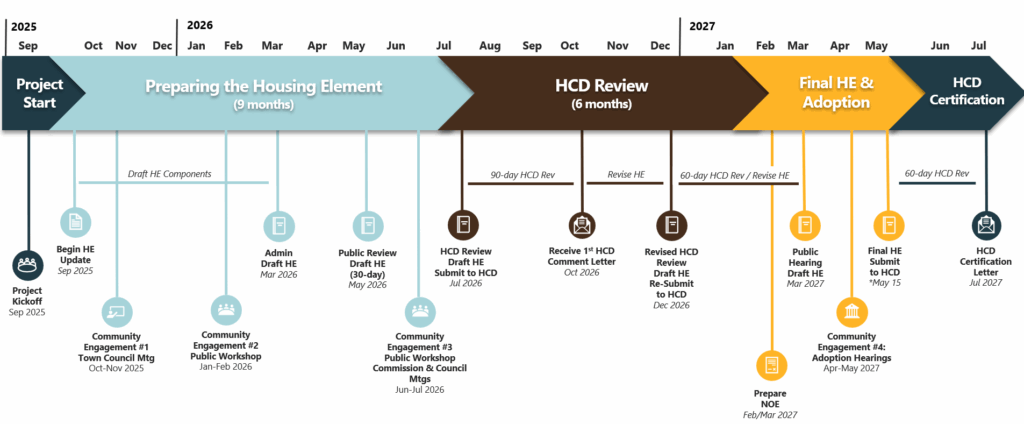
The Town of Truckee began updating the housing element in September 2025, and is planning to provide initial information during a Town Council meeting sometime in late October or November. More information about the town’s housing element update process can be found here. All jurisdictions in the state are required to create and update their housing element. Placer County and El Dorado County’s current housing elements run through 2029. Nevada County’s housing element runs through 2027, so Nevada County will likely start their update process soon. The chart below outline’s the Town of Truckee’s timeline for completing the Housing Element.
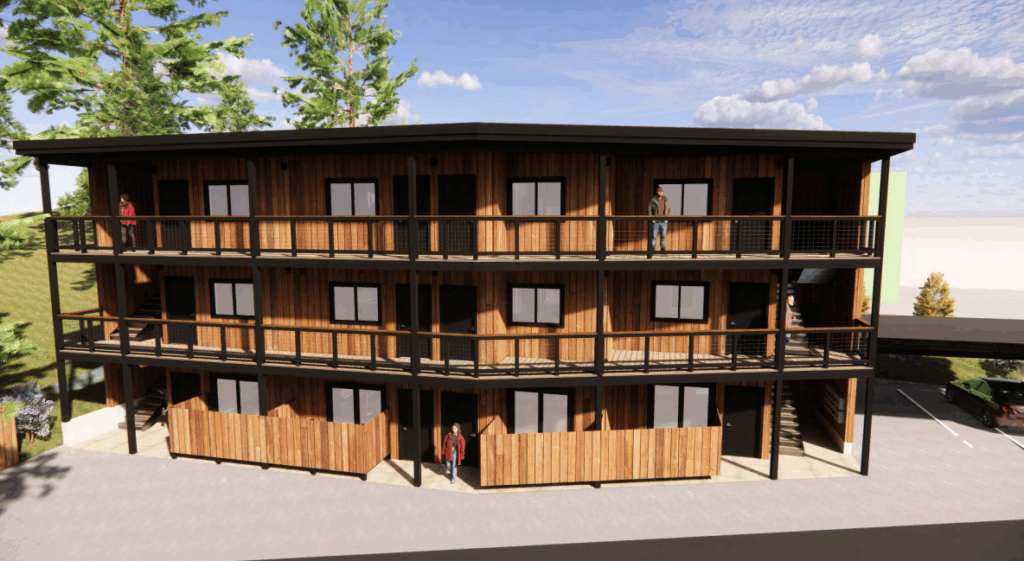
Artist rendering of Edmunds Lofts, a 12-unit workforce housing project located on Edmunds Drive near Meadowood Park in Truckee.
Housing 101: Breaking Down California’s 2025 Housing Legislation
September 18, 2025
The California Legislature ended its 2025 session over the weekend with a slew of new housing initiatives aimed at reducing costs and speeding up the process to build housing. The legislature passed a total of seven bills that now sit on Governor Newsom’s desk. He has until October 12 to sign or veto the bills.
**It’s important to remember that since development in the Lake Tahoe Basin is governed by the Tahoe Regional Planning Agency under a bi-state compact, state law sometimes doesn’t immediately apply or is modified within in the Tahoe Basin. Here’s a breakdown of the legislation:
Speeding Up Housing Approvals
AB 253 – The housing “shot clock” speeds up approvals by allowing home builders to hire a licensed third-party reviewer if local agencies can’t complete a permit review within 30 days.
AB 1308 – Creates another “shot clock,” this time for inspections. Jurisdictions must complete final inspections within 10 days for new residential buildings or additions of 1–10 units.
Expanding Housing Opportunities
AB 79 – Makes it faster and easier to build multifamily housing near transit stops, with requirements tied to the type of transit, its frequency, and the distance from housing to transit.
AB 1061 – Extends the provisions of SB 9 (2021)—which allows for lot splits and duplexes in single-family neighborhoods—to historic districts if existing historic structures are not altered or demolished.
Supporting ADUs and JADUs
SB 9 (2025) – Despite sharing the same number, this is different from SB 9 (2021). It reforms ADU ordinances by requiring local governments to bring them into compliance with state law and gives HCD the authority to void any local ordinances that create barriers to ADU construction.
AB 1154 – Clarifies rules for Junior ADUs (under 500 sq. ft.) by creating a unified set of standards, resolving confusion from overlapping rules, and making approvals faster and easier.
Making Housing More Accessible
AB 413 – Requires the Department of Housing and Community Development (HCD) to translate key state housing guidelines and handbooks into the non-English languages commonly spoken in California, so more homeowners and builders can understand their housing options.
Local Spotlight: Tahoe Basin
Closer to home, the Placer County Planning Commission recommended approval of the Tahoe Basin Area Plan Phase 2 Housing Amendments Their recommendation now moves to the Placer County Board of Supervisors, who will make a final vote on the Amendments later in 2025.
The Phase 2 Amendments apply to housing projects that are 100% deed-restricted and located within town centers in Kings Beach, Tahoe City and other areas zoned for multifamily housing and allow for greater flexibility related to building height, density and parking.
These new housing bills highlight the state’s ongoing efforts to address housing challenges by focusing on faster approvals, expanded opportunities, and clearer rules. Locally, we’re working closely with the Tahoe-Truckee Workforce Housing Agency, which has partnered with Sierra Business Council on state-level housing policy initiatives. You can track statewide legislation and get more in-depth analysis here.
This collaboration helps ensure our region’s housing needs are represented in Sacramento. We’ll also continue to share updates as these laws take shape and as local changes—such as the Tahoe Basin amendments—move forward. By staying informed, our community can better understand the evolving housing landscape and the opportunities ahead.
Share
STAY INFORMED AND STAY CONNECTED
Get important updates and timely information about workforce housing in our region.