Housing in Tahoe/Truckee on the Regional and Statewide Radar
August 12, 2025
In July, the Tahoe Regional Planning Agency (TRPA) hosted the second round of community workshops for the Tahoe Living: Cultivating Community, Conserving the Basin project. At the North and South Shore meetings, more than 100 community members and workforce housing stakeholders provided input on fundamental changes to the permitting process for affordable housing projects and accessory dwelling units. TRPA has been hosting a series of bi-lingual workshops, webinars and working groups for the second phase of Cultivating Community, Conserving the Basin. The goal of this multi-year project is to create meaningful policy changes that can make housing more accessible in the Tahoe Region while maintaining and improving environmental protections. You can learn more about the project objectives, timeline, and how to get involved at tahoeliving.org.
Also in July, the Tahoe Truckee Community Foundation hosted Tomiquia Moss, California Secretary of Business, Consumer Services, and Housing for a dynamic conversation with local housing agencies and organizations including the Tahoe Housing Hub, Placer County, Town of Truckee and the Tahoe Truckee Workforce Housing Agency. Local housing leaders articulated Tahoe Truckee’s full housing landscape, from rural homelessness to workforce housing gaps and rising fire insurance costs to where State policy can leave mountain communities behind. The Secretary and her team came to learn about Tahoe-Truckee’s regional housing and forest-to-housing efforts as part of a greater, statewide effort hosted by the League of California Community Foundations.
LAKE TAHOE, Calif./Nev. – Building housing in any area requires a wide spectrum of housing, from transitional to affordable to market-rate and above. But because of pre-existing codes specific to the Tahoe area, building for the “missing middle” or multi-family housing is deeply disincentivized. And with continually rising market rates in the region, it makes it necessary to solidify housing within a certain area median income (AMI), though it often goes to affordable housing. For this article in the Tribune’s housing series, we’ll explain how these codes and contracts have impacted housing in Tahoe, and what changes are on the horizon for them.
What are development rights?
Even for those not in the know about development in the region, it’s still widely understood that Tahoe has garnered a reputation for being difficult to build in. The Tahoe Regional Planning Agency (TRPA) is responsible for creating Tahoe’s development rights system back in 1987 to disincentivize building and development. In the past, it’s undergone many changes in response to changing conditions in the region, but here’s how it works as it currently stands.
In order to develop a parcel of land in Tahoe, a developer must attain all the standard rights and permits as well as a development right. These are classified into three different types: tourist accommodation units (TAUs), commercial floor area (CFA) and residential units of use (RUUs).
To obtain development rights, developers can purchase them from the TRPA or through the TRPA’s marketplace from other developers who hold development rights. They can also purchase them from building departments or from the California Tahoe Conservancy (CTC) or the Nevada Tahoe Resource Team’s (NTRT) land banks. Lastly, developers can get development rights from buying and then restoring sensitive land parcels, which is also how the CTC and NTRT have banked their development rights. Development rights can be transferred from one property to another and can even be converted as the graphic shows.
A table showing how development rights are calculated between units.
However, one major oversight that the TRPA and the Tahoe Living Working Group (TLWG) identified is how development rights also disincentivize building affordable and multi-family units. No matter what size it is, an RUU is an RUU, meaning that to make the most of purchasing a development right, building bigger and more expensive housing pays better. Not only that, but an RUU also only counts for one. If a developer wants to build a triplex, then they need three RUUs, making it less appealing and more expensive to have multiple units on a parcel.
Robb Olson, a developer, architect and member of TLWG has primarily worked on custom homes and second homes. His clients typically have enough money to pay for the many restrictions and fees imposed on building in the basin, but he recognizes that’s not true for every development. “Uncertainty kills projects,” said Olson, “And much of what we do can be a weird, awkward process. It takes persistence to get to the finish line.”
According to Olson, the development rights marketplace can be a feast or famine situation, often with rights locked to the specific region of the basin that you’re in. These fees can be debilitating and come from multiple agencies, often requiring homeowners or new developers to invest time in learning the ins and outs or pay someone to help them through the confusing process.
In the case of some projects, these fees can build up to the point that what could have been workforce housing is removed or reduced in order to make the project pencil. Olson recounted a hunting lodge they were interested in turning into housing—but the eventual cost meant that the only profitable way to use the property was short-term rentals.
Bonus units and deed restriction
To make building housing more appealing and less expensive, the TRPA offers bonus units in exchange for deed restriction of a property.
Essentially, the TRPA keeps a certain amount of RUUs that they can grant for free, called bonus units. This reduces the cost for the developers and allows them to add more units. The TRPA has a certain number of bonus units they hold onto, and the pool is allocated so that 50% goes to affordable housing, 25% goes to moderate housing, and 25% goes to achievable housing. However, because affordable housing has been a major focus, the lower AMI focused tiers can pull from the higher tiers, meaning that in actuality, a higher percentage than half usually goes to affordable housing.
In exchange for these bonus units, the developer must adhere to the legal stipulations in the deeds indefinitely. Here in the basin, typically deed restrictions refer to keeping the prices for the property at a certain AMI, which maintains a housing supply of affordable housing.
The TRPA provides jurisdictions around the basin with bonus units that can be granted and with residential allocations, which are a development right used to create RUUs. The pools for each of those can be seen in the following graphic.
A reflection of basin-wide jurisdictions’ bonus units and residential allocations, as of June 25th, 2025.
Deed restriction challenges
Even outside of the TRPA’s jurisdiction, deed restriction is a key component for keeping prices more manageable for housing—the town of Truckee utilizes deed restriction in many of its properties across the AMI spectrum. But it presents its own challenge.
Deed restrictions here are often best incentivized through affordable housing. That’s not to say affordable housing isn’t necessary, but it does mean that new properties being built through deed restrictions are often for affordable housing, meaning the missing middle continues to miss out on new units that are being built.
As with recent projects like Dollar Creek Crossing, pitching deed restriction for mid-range AMIs is often a money sink. Private investment in the housing sphere is typically targeted towards affordable housing, where the federal government incentivizes it through low-income housing tax credits (LITC). For achievable, moderate and market-rate housing, no such incentives exist.
Local land trusts like St. Joseph’s Community Land Trust often make it easier for developers to leverage LITC. But awards for these projects often go to out-of-town developers—a large portion of the affordable housing here is built and managed by The John Stewart Company, whose closest office is in Sacramento. Some local developers have expressed that they feel like they’ve been passed over by county or city officials and that they don’t get a fair shake at creating affordable housing.
Patrick Taylor, owner of Alpine Corporation, has been trying to build deed restricted, achievable workforce housing in the region as a local in the area. He’s been working on the issue for years, but says that code changes and land shortages have made it far more challenging.
“There’s plenty of fees and loans that have to be dealt with,” said Taylor, referencing the development rights costs, fees for construction from multiple agencies and lawyers to help ensure deed restriction and other documents are legally binding. “There are these big hurdles and a multitude of agencies and requirements. Slimming that down would make the process much more streamlined, but right now, there are too many hands in the cookie jar, and miscommunication among a lot of them.”
Developers like Taylor have long expressed a desire to cut down the bureaucracy, and a high interest in increasing workforce housing incentives in residential and commercial areas. These would help protect environmental initiatives by reducing the need to commute, bringing people closer to public transit and their places of work.
The future of development rights
To its credit, the TRPA recognized the negative impacts that current development rights code has had on housing, and Phase 3 of the Cultivating the Community, Conserving the Basin plan (also called Tahoe Living) includes major code changes.
Currently, the summer and fall of this year is dedicated to exploring, defining and testing policy recommendations, including changes to the development rights system and associated codes. The end stage is expected to take place in winter and spring of 2026, where policy and code updates will be finalized.
Development rights are fairly restrictive in the Tahoe Basin, but not necessarily unique. Other areas of California, Maryland, Washington, New Jersey, New York and Colorado have development rights systems that the TRPA studied in 2021 to improve their system—some of which are being supported by TLWG and other housing advocates.
Olson laid out some of what TLWG members have been speaking about in recent meetings.
Re-evaluating coverage
Land coverage is an associated concept with development rights, as it monitors the use of human-made structures that replace the soil and change how sediment enters the lake. However, Olson hoped that potentially looking at increasing coverage for homes that are otherwise infiltrating their water or are located in town centers would make it easier to streamline building them. “Housing is mitigation enough,” said Olson, “Especially in town centers, it reduces VMT (vehicle miles traveled) and gets people using transit.”
Re-evaluating fees
There are fees aplenty in the Tahoe Basin, many of which unintentionally do the same thing as development rights and make it harder to build multiple units of housing. For example, VMT fees are evaluated per unit and are roughly $3,000—making it hard to justify building apartment complexes and other multi-family homes. “There are also a lot of fees that are missing because there’s a lack of equity in how those fees are applied,” said Olson. “Having agencies collect those missing fees could offset the cost of workforce housing.”
Codes and subsidies
While the TRPA reduces four possible fees for deed restricted housing, Olson asserted there is a need for true subsidies beyond these and bonus units. For example, agencies and jurisdictions could utilize a checking system that prioritized funding workforce housing projects with proximity to town centers and/or transit. Or they might focus on square footage of units rather than flat rates per unit, which would incentivize building more multi-family residences.
Fractional units
In Truckee, rather than counting bonus units as the same regardless of size, their bonus units are fractional. For example, a studio is equivalent to 0.5 of a bonus unit, while a two- or three-bedroom apartment is counted as 1 bonus unit. Olson called this a “compelling idea”, as more closely considering fractional units would make it easier to award more housing to deed restricted projects, as well as making it easier to get development rights for larger housing complexes.
The complex legal systems that are meant to protect Lake Tahoe’s environment have shifted in the past, and this major effort could make it easier for the basin to build workforce housing and match the growth happening in the region.
If you want to contribute to the TRPA’s conversations on development rights and other policies, they have two upcoming meetings in July. The South Shore workshop takes place on July 22 from 5 p.m. to 8 p.m. in the Bijou Community School, while the North Shore workshop takes place on July 23 from 5 p.m. to 8 p.m. in the Tahoe Community Foundation Trepp Room.
When we launched the Tahoe Housing Hub’s ADU Accelerator Pilot Program in late 2024, we were ambitious. We set out to support the construction of 20 accessory dwelling units (ADUs) in two years and build momentum from there.
The response was strong – over 100 people joined our interest list prior to launching the program, and more than 60 homeowners have since completed applications. Its clear residents want to be part of the solution but building ADUs in the Tahoe-Truckee region is anything but easy.
A year in, we’ve learned the same challenges that make construction difficult in the Tahoe-Truckee region—high costs, short building seasons, and a complicated permitting process—also apply to ADUs. Building a small unit doesn’t necessarily mean small challenges.
In response, we’ve had to get creative – exploring new approaches to construction, design, financing, and permitting in hopes of making ADUs more feasible for homeowners.
Traditional Construction vs. Prefab
The cost of traditional ‘stick-built’ construction cost is simply too high for most people to build an ADU. To address this, we’ve researched financing options, local housing incentive programs, and explored prefab and modular construction companies to find a low-cost solution to our high snow load environment.
Prefab and modular units are built off-site in a controlled environment, then transported and installed on your property. The quality is excellent, energy efficient, and often incorporates sustainable design and construction materials. They can also reduce construction time and minimize weather delays. You can get anything from a 450 to a 1200 square foot ADU built this way, and the costs are significantly less than traditional construction.
If you’re considering prefab, it’s essential to do your homework. Some companies don’t have experience building in our region, and many models aren’t designed to meet our snow load or energy efficiency requirements. Ask if they’ve installed ADUs in the Tahoe region, whether their models are engineered to meet local codes, and if they can provide references from similar mountain climates. Also, be sure to compare the total cost of the project—not just the base price of the unit. Site work, foundation, utility hookups, and permits can significantly increase the final price.
The Town of Truckee has more detailed information on the different types of prefab ADUs, links to snow load requirements and local building and design criteria. Their site also provides links to several prefab companies. It’s important to note that the town’s prefab company list is informational only, and some of those companies may not be able to provide a product that meets the required snow loads in our area.
How the ADU Accelerator Can Help
If you are interested in a prefab ADU, please reach out to us. We are currently developing a list of prefab ADU companies with products that meet our region’s snow load requirements that we hope will help homeowners as they explore prefab ADU options.
Every ADU that is built in conjunction with our ADU Accelerator Pilot Program provides a home for a local worker. As we continue to learn what works—and what doesn’t—we’re focused on helping homeowners navigate the complexities of building in this region. Program participants receive free technical assistance as they navigate the permitting and construction process. We also cover all or some of the cost of additional pre-construction services like site surveys, land use planning, engineering and design.
Homeowners who participate in the program agree to rent their ADU to a local worker and can choose two different options: rent at market rate for 5 years or rent at a lower rate set by HUD for 3 years. The ADU Accelerator program is made possible by a grant from the Martis Fund and the North Tahoe Community Alliance’s TBID/TOT Dollars at Work Program. For more information visit www.tahoehousinghub.org.
Housing 101: 700 on the Waitlist – Tahoe’s Affordable Housing Reality
June 18, 2025
The complexities surrounding affordable housing often lead to confusion. Terms like workforce, achievable, and affordable housing are used interchangeably, yet each describes a critical part of the region’s housing challenges. At its core, affordable housing simply means having enough homes at prices accessible to all community members, regardless of income.
Mountain Housing Council, a program of the Tahoe Truckee Community Foundation, has been working since 2017 to identify and define who in our community needs housing, if and what the barriers are to affordability, and how our region can address the problem. Their research consistently reveals significant unmet housing needs. The latest report from 2023 identifies a startling gap—approximately 8,200 housing units are urgently required across various income levels, family sizes, and housing types. These comprehensive reports provided the first real data on the range of unmet housing needs in our region and spurred urgent discussion and action within our communities. The work we do at the Tahoe Housing Hub is a direct result of the groundwork laid by the Mountain Housing Council.
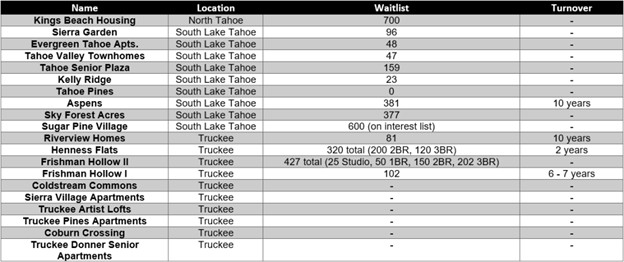
For many residents, these numbers seem abstract. However, a recent Tahoe Daily Tribune article vividly illustrates the depth of this crisis through real-world implications. It reports that nearly 700 people are currently on waitlists for the limited number of available affordable housing units—homes specifically priced for those earning 80% or less of the area median income (AMI). The article further notes infrequent turnover, highlighting how rarely new opportunities become available.
It’s natural to question, “Do we really need more affordable units in Tahoe?” Yet, the waitlist data provides a clear and direct indication that the demand is very real. Addressing this critical housing shortage is fundamental for maintaining the strength and stability of our community.
The Tahoe Housing Hub continues working actively to address these housing needs, advocating for solutions while helping to increase the number of affordable units available to residents through the ADU Accelerator program. This important work is part of a broader collaborative effort across the region involving partners such as Placer County, Town of Truckee, Truckee Tahoe Workforce Housing Agency (TTWHA), and the Mountain Housing Council (MHC), among others. Together, these groups demonstrate a regional commitment to resolving our housing challenges.
*Housing Chart Source: Tahoe Daily Tribune. The City of South Lake Tahoe requires property managers to keep track of turnover and wait lists. The data is not available for many of the properties located in Truckee.
If you’ve been part of a housing conversation lately—at a public meeting or chatting with neighbors, chances are the term “deed restriction” has come up. It may sound like legal jargon, but it’s a tool that has been used for decades to help guide how housing is used and who it serves.
What Is a Deed Restriction?
A deed restriction is a legally binding agreement that limits certain aspects of how a property can be used. It “runs with the land,” meaning it stays in place when the property is sold or transferred. The two most common types are:
Income-Based Restrictions limit who can rent or buy based on income – typically for those making less than the average income within a community. This model is used mostly for rental housing, where rents are limited to ensure households spend no more than 30% of their net income on housing.
Local Employment or Residency- Based Restrictions (aka “Local-Worker Restriction) prioritize full-time workers or residents of a community. These may include higher income caps and support the “missing middle”—those who earn too much for traditional affordable housing but still can’t afford market-rate prices.
Why They Work – and Where They’re Used
In North Lake Tahoe-Truckee, deed restrictions have been part of the housing strategy for more than 20 years. Projects like Frishman Hollow, Sierra Village Apartments and Kings Beach Housing provide deed restricted for sale and rental housing for a range of local workers: teachers, first responders, ski lift operators, restaurant workers and more.
Other communities, like Vail Colorado, have expanded these efforts. Vail’s InDEED program offers up to $200,000 to homeowners in exchange for a local worker deed restriction – without resale limits or income caps. This model has preserved over 165 homes and demonstrates that flexible programs can work. More examples are featured in the 2023 Workforce Housing Report.
Not One-Size-Fits-All—Especially for ADUs
Deed restrictions aren’t one-size-fits-all, and in some cases, applying them too rigidly can backfire. That’s especially true for homeowners building ADUs. Large scale housing developers might be willing to take on 55-year deed restrictions, but expecting an individual homeowner to do the same can actually discourage participation.
That’s why local programs are beginning to explore more flexible deed restriction models: shorter terms, rent caps, or incentive payments that still support local housing without placing too much burden on homeowners.
Resale Value for Deed Restricted Homes
For many homebuyers considering a deed-restricted property, it’s natural to wonder how a restriction might affect future resale value. Many deed restriction programs are designed to preserve affordability while also allowing homeowners to build modest, meaningful equity over time. For example, in some cases, resale prices for deed restricted homes are tied to changes in the area’s median income. In other cases, homeowners can sell their property at market value, if the buyer is a local worker.
AProven Tool—When Applied Thoughtfully
Deed restrictions have been a proven part of housing strategies in communities across the country but like any tool, they aren’t one-size-fits-all. The most successful programs are those that apply deed restrictions where they work best—and are willing to modify or adapt them in situations where they may not. For a deeper look at how deed-restricted homeownership works and the different ways communities apply it, check out some of these resources.
What is Permanent Supportive Housing and Why Does it Matter in Tahoe-Truckee?
April 16, 2025
The Tahoe Housing Hub is guided by a set of core beliefs. At the top of that list is the belief that housing should be available to all in our community. What that means to us is stable, dignified housing for our friends and neighbors, local workers, families, retirees and the unhoused. Despite our cold and snowy winters, too many of our neighbors are unhoused, often living in cars, tents, or unstable temporary arrangements.
What is Permanent Supportive Housing?
Permanent Supportive Housing (PSH) is a proven, effective solution that helps people exit chronic homelessness by providing affordable housing paired with individualized support services. It is not a homeless shelter, a group home, or a halfway house. It is long-term, stable housing—often apartments—with leases, just like any other housing. What makes it “supportive” is that residents also have access to services like:
Mental and physical health care
Employment and job training
Childcare and food assistance
Substance use recovery support
These services are voluntary and tailored to each resident’s goals. The PSH model is built on the understanding that stable housing is the foundation from which people can rebuild their lives.
Tenants in PSH sign leases and pay rent—often around 30% of their income, which may include disability or Social Security benefits. An on-site manager or service coordinator helps connect residents to services and ensures the property is well-maintained and supportive. PSH housing looks different depending on the community. In urban areas, it’s often part of apartment-style developments that include a mix of affordable and supportive housing. But in the Tahoe region, we’ve adapted the model to fit the local housing stock and community context.
Does PSH Work?
Yes—and the research backs it up. Studies show that PSH:
Lowers the use of emergency services, including hospitals and jails, saving taxpayer dollars (SAMHSA – Permanent Supportive Housing: The Evidence (PDF))
A 14-unit PSH facility opened in the Kings Beach area in 2024 and is now home to individuals who were already living in our community – some in tents, cars, or unstable situations. The location was intentionally chosen – close to services, groceries, and public transit. Residents now have a foundation for health, stability, and growth. You can watch a video about the project and meet some of its residents here.
Looking ahead, a new PSH project in Truckee will get underway in the summer of 2025 at the former CHP site near the intersection of Hwy 80 and State Route 89. The project is a 55-unit affordable housing apartment complex and will include 10 units of PSH with on-site management and support services.
Why This Matters Now
Each year, about 117 households in the Tahoe-Truckee region access homeless services. But only one-third are placed in stable housing. That means many of our neighbors remain unhoused, cycling between temporary shelters, camps, and emergency care.
The recently released draft Tahoe Truckee Regional Homeless Action Plan outlines a five-year plan to address this issue with PSH as a cornerstone strategy. The action plan recommends solutions like PSH’s as a key tool for success. You can read the full plan here.
PSH is not just about housing. It’s about belonging, recovery, and hope. It’s a path forward for individuals and families who have faced extraordinary challenges—and an opportunity for our community to come together with compassion and care. At the Tahoe Housing Hub, we’re proud to support solutions that work—and to help create a future where everyone has a place to call home.
The term ADU is being tossed around more and more often, but do you know what ADU really means? It’s short for accessory dwelling unit, or basically a fancy word for what most of us think of as guest houses, mother-in-law units or garage apartments.
If you’ve ever looked out at your yard, or inside your crawlspace or rec room and thought: I wonder if I could do something more with this space? The answer might be to turn it into an ADU.
ADUs might seem like a new-ish trend, but the concept of standalone living quarters isn’t. The term itself has been floating around since the 1980s, and recently, ADUs gained serious traction as part of the solution to the housing crunch. In simple terms, an ADU is a fully independent unit complete with the basics: its own kitchen, bathroom, and sleeping area that can only exist secondary to your main house.
So, what’s all the buzz about them? ADUs are more than just a cool backyard project, they’re a game-changer. Maybe you’re thinking about downsizing but love where you live. Maybe your parents need to be closer, but not too close. Or maybe your adult kids are back home trying to save up for their own place (because let’s be honest, housing prices aren’t getting any cheaper). Beyond personal benefits, ADUs are also backed by state law as a tool to tackle the housing shortage. That means they’re intended for long-term housing, not short-term vacation rentals – so if you were dreaming of an Airbnb side hustle, this isn’t the route. The goal here is stable, sustainable housing that fits different income levels, life stages, and household needs.
Real estate prices in the Tahoe-Truckee region keep climbing and finding an affordable investment property or helping a family member buy a home can feel nearly impossible, but adding an ADU is way more doable. Yes, it still is a significant investment, but compared to buying another property, it’s a smart long-term move. It can add value to your home, create a reliable rental income, and contribute to the local housing market. All without drastically changing the character of the community.
For homeowners who love the area but don’t live here full-time, an ADU can be a great way to stay connected to the community. Renting it out to a local worker or hiring a caretaker ensures the property is well maintained and contributes to a vibrant neighborhood.
Concerns about density and parking often arise, but ADUs are a thoughtful, gentler housing development option that blend into neighborhoods without overwhelming them. If you’re curious about building an ADU, the Tahoe Housing Hub’s ADU Accelerator Program offers free step-by-step support to walk you through the entire process. With the right guidance, turning an underutilized space into a livable unit becomes much more achievable.
Share
STAY INFORMED AND STAY CONNECTED
Get important updates and timely information about workforce housing in our region.