< Back to Stories

Voices for Housing Episode 4: Alison Part 2

May 20, 2026

This is part 2 of Alison’s story. After years of moving from one rental to another, she and her family reached a tipping point – move out of the area or stay and find a forever home. Alison shares more about the difficulty of first-time home ownership in the Tahoe region and how they made it work.

The Voices for Housing campaign is made possible thanks to a generous grant from the North Tahoe Community Alliance’s TOT-TBID Dollars at Work Program.

< Back to News

A Tahoe nonprofit is using storytelling as a tool for solving the housing crisis

April 14, 2026

Maria Palma – March 20, 2026

https://www.kunr.org/local-stories/2026-03-20/a-tahoe-nonprofit-is-using-storytelling-as-a-tool-for-solving-the-housing-crisis

Tahoe Housing Hub recently launched a storytelling campaign called “Voices for Housing” with the goal of bringing visibility to stories often absent from public discussions.

“We really thought that it was important to focus on the personal stories of our local workforce, our local workers, and just let them tell their housing stories and tell their successes as well,” said Shelly Purdy with Tahoe Housing Hub.

Ten short films will be released throughout the year, showcasing a wide range of people from different backgrounds. Purdy said that mix is intentional.

“Because it really shows that the housing issue impacts the entire community as a whole,” she said.

Two films have already been published. They tell the stories of Xander, a professional skier raised in Truckee, who returned after college to build his life. And Mary, a local artist and retiree, who shares her deep connection to Kings Beach.

The campaign is funded by a grant from the North Tahoe Community Alliance.

< Back to News

TTCF, TRPA align housing findings, highlight regional workforce housing crisis

April 14, 2026

Staff Report – Feb. 23, 2026

TAHOE REGION, Calif./Nev. — For the first time, the Tahoe Truckee Community Foundation (TTCF) and the Tahoe Regional Planning Agency (TRPA) have aligned findings from their respective housing needs analyses, revealing consistent and urgent housing challenges across the greater Tahoe region. While the two studies examine slightly different geographies, the results point to the same conclusion: there is a significant mismatch between housing supply and the local workforce’s needs.

“Since 2016, investments in regional data have helped us track progress towards achievable local housing solutions* with the many housing efforts across agencies,” said Stacy Caldwell, TTCF CEO. “This aligned data shows that most unmet need remains on working households, which are essential to our community. This moment calls for continued coordination and locally driven solutions that match the scale of the need.”

Key takeaways


  • In-commuters (those who commute into the Tahoe-Truckee area but would prefer to live in the region) represent the largest share of unmet demand,
  • 50% of renter households are overpaying for housing, compared to 34% of homeowners,
  • 65% of Tahoe – Truckee housing stock is held for seasonal and occasional use,
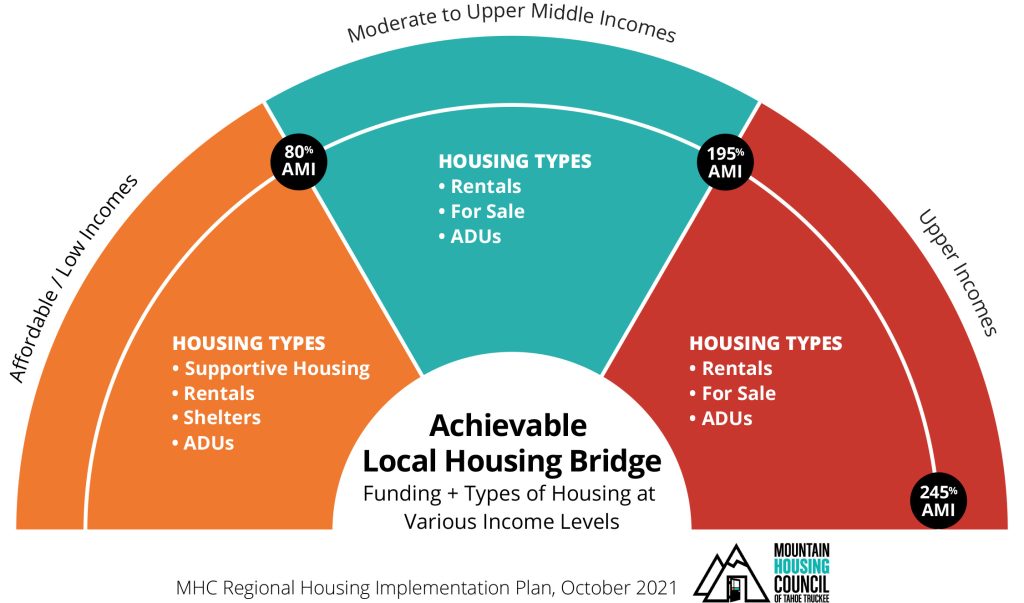
  • 245% – 255% of Area Median Income** (AMI) could be required to purchase a median-priced single-family home in the broader region.

Achievable Workforce Housing Gaps Persist

The housing studies show that unmet housing needs continue to impact achievable local housing, from the unhoused to those making 245% AMI, or the “missing middle.” This expanded definition of affordability- originally developed by the Mountain Housing Council in 2021 and adopted by TTCF, TRPA, and regional housing partners- improves our region’s ability to address local housing needs. This unmet need includes those who are inadequately housed (e.g., in overcrowded conditions or substandard housing) as well as those in need of housing, spanning the resident workforce, in-commuters, and seasonal workforce.

Comparing TTCF’s housing data from the 2016 study, affordability has generally worsened throughout the community, with higher incomes being required to afford market-rate housing. The new data for the Tahoe Basin show the same widening affordability gap, although the overall level of housing need has risen only slightly from earlier studies.


Provided / TTCF

In-Commuter Data Suggests Workforce Displacement

TRPA data confirms a substantial number of workers commute into the Basin but would prefer to live closer to their jobs — a pattern that increases vehicle miles traveled (VMT) and affects environmental outcomes. TTCF’s analysis echoes this finding.

Furthermore, TTCF notes that current data primarily capture in-commuters and does not fully quantify residents who have already been displaced from the region, suggesting the true housing pressure may be even greater.

“Housing and environmental sustainability in the Tahoe Basin are deeply connected,” said TRPA Long Range Planning Director Karen Fink. “When workers are forced to commute longer distances, it increases vehicle miles traveled and impacts Basin health. These findings will help inform the next phase of the Tahoe Living initiative.”

Testing Assumptions and Designing Solutions

Both TRPA and TTCF hosted data walks to test the quantitative data against the lived realities and observations of those organizations and agencies that serve the people of our regions. These walks affirmed the data and also pointed to the interventions that are working. For example, Sierra Community House provides one-time rental and utility assistance to help people remain housed during emergencies, the collaborative efforts of Tahoe Truckee Workforce Housing Agency, and free transportation solutions through Tahoe Truckee Area Regional Transport (TART) to aid commuting.

Data Will Continue to Inform Regional and Local Housing Strategies

TRPA will use its findings to guide the Cultivating Community, Conserving the Basin phase of the Tahoe Living policy initiative, currently in the scoping phase of an Environmental Impact Statement. Proposed policies in the environmental analysis include changes to the growth management system that would scale certain regulations and incentives by the size of residential units, something the new data points to as an area of concern and possible driver of environmental impacts. Learn more at http://www.tahoeliving.org/housingassessment.

TTCF will share the results with local housing authorities in Nevada and Placer Counties, the Town of Truckee, and alumni partners of the Mountain Housing Council to help advance locally driven housing solutions. TTCF has facilitated housing needs assessments in 2015, 2016, 2021, and 2023 to accelerate housing solutions in North Tahoe-Truckee. The full report is available at http://www.ttcf.net.

< Back to News

How area plans help incentivize housing

April 14, 2026

By Eli Ramos – Feb. 13, 2026

LAKE TAHOE, Calif./Nev. – Area plans, also called community or specific plans, help keep local control, flexibility and character of the area that they cover, and are an essential function of the Tahoe Regional Planning Agency’s (TRPA) Lake Tahoe Regional Plan. But how do these area plans address housing? And how have they changed as the Phase 2 amendments of TRPA’s housing plan have taken effect? In this month’s housing series article, the Tribune takes a look at different area plans and their specific housing policies.

What is an area plan?

Area plans, as defined by the TRPA, are plans created by local governments with community members and stakeholders to help implement the policies of the regional plan at a community scale. They contain land use goals and policies, along with zoning and regulations, permit requirements, development and design standards. They also contain goals and policies around transportation, conservation, recreation, public services and housing.


These area plans serve as the framework that provide the incentives for coverage, density and height, but they have to be built into the plan before they can be made available to a developer or to the public. Plus, they still need to fall within the allowable use of the regional plan as dictated by the TRPA.

And while California or Nevada rules may differ for things like accessory dwelling units or parcel divisions, because the Lake Tahoe area is governed by the bistate compact of the TRPA, their rules come first.


Outside of the TRPA, area plans are also called specific plans, which can help with determining more local control under a general plan. These can help with the framework of additional regulations that help achieve the goals of the general plan, and may be more difficult to achieve solely through regulations like zoning.

What priorities does the regional plan promote for housing?

In general, TRPA’s regional plan promotes environmental redevelopment and sustainable economic development, especially in the creation of town centers. This promoted higher density and height along with housing in town centers, along with transit and walkability in these areas, which also would reduce vehicle miles traveled in these sections. These were paired with incentives for housing, such as deed restrictions, bonus units and changes to coverage.

In 2023, the TRPA’s Phase 2 Housing Amendments intended to make deed-restricted and multi-family projects more financially viable, which impacted local plans. To become consistent with the new regional policies, local amendments were made to area plans or counties adopted the regulations put forth by the TRPA.

What area plans are out there?

  • Washoe County: Tahoe Area Plan
  • Placer County: Tahoe Basin Area Plan, Alpine Meadows General Plan, Martis Valley Community Plan, Olympic Valley Area General Plans
  • Douglas County: South Shore Area Plan; proposed Tahoe Douglas Area Plan
  • El Dorado County: Tahoe El Dorado Area Plan (TED Area Plan); will update and incorporate the Meyers Area Plan
  • City of South Lake Tahoe: Tahoe Valley Area Plan, Tourist Core Area Plan; the Y Industrial Area Plan and the Mid-Town Area Plan are currently in development

Washoe County – Tahoe Area Plan

Washoe County’s area plan has a community vision statement that expresses interest in providing a range of housing opportunities while also respecting private property rights and respecting the heritage of the area. Their land for residential use exists with the regulatory zones of Chateau, Crystal Bay and Crystal Bay Condominiums, Fairway, Incline Village 1 through 5 and Residential, Lakeview, Mill Creek, Mt. Shadows, Stateline Point, Tyrolian Village and Wood Creek. They also included some housing in the Incline Village Commercial Area and Ponderosa Ranch.

Senior Planner Kat Oakley said that they heard feedback from citizens regarding Phase 2 Housing Amendments and proposed to adopt some parts and modify others—proposing a half parking space per unit in town centers and a shorter maximum height of 56 feet, which was the pre-existing maximum height. However, Washoe County ultimately opted into the parking reductions down to 0 spaces per unit with an approved parking study that showed that all parking needs would be met, as well as the 65 feet maximum height.

However, Oakley said, “Washoe County was still able to adopt the change to allow deed-restricted multi-family housing in Ponderosa Ranch to further support opportunities for workforce housing.”

“In the Tahoe Basin, area plans have the dual function of providing a vision for the future of that particular area and enabling more local control over zoning regulations,” said Oakley. Recent amendments focused on the zoning aspect, but the vision for the character focuses on maintain a year-round population, continuing tourism as the central economic anchor for the area and maintaining natural resources.

“Since area plans include zoning regulations, they play a very direct role in housing. There are more incentives now for affordable, moderate and achievable deed-restricted housing. We also expanded opportunities for accessory dwelling units, which could help with housing provision,” said Oakley. “Zoning regulations are one piece of the puzzle—they can allow the types of housing we want to see in appropriate places, and they can create regulatory incentives. The Washoe County Tahoe Area Plan has both of those pieces.”

Still other pieces such as funding, land availability, land cost and development costs also prevent challenges that Oakley says can’t be overcome by zoning regulations alone.

You can read Washoe’s current area plan at https://www.trpa.gov/wp-content/uploads/WTAP_Full_121725-1.pdf

Placer County – Tahoe Basin Area Plan and others

Placer County states in their area plan that they are trying to create affordable, moderate and achievable housing. The land for residential use exists within the subdistricts of Kingswood West, Lake Forest, Lake Forest Glen, Mark Twain Tract, McKinney Tract, Rocky Ridge, Sunnyside/Skyland, Tahoe Estates, Tahoe Park/Pineland, Tahoe Pines, Tahoe Vista Residential, Tahoe Vista Subdivision, Talmont, Tavern Heights, Timberland and Woodvista. They have several mixed use and town center subdistricts within Greater Tahoe City, North Tahoe East (including Kings Beach), Tahoma and Sunnyside.

Principal planner Emily Setzer noted that Placer County also accepted the Phase 2 Housing Amendments from the TRPA. “We brought the option to have an alternative set of proposed amendments, but it would have required us to create a financial feasibility statement and much more work on our end, and we didn’t hear an alternative from our public workshops.”

Setzer also said that the Phase 2 amendments ultimately achieved the same goal of getting housing costs down and making them more feasible within the area. However, the multi-family housing amendments have been harder for Placer County to utilize, as they do not have enough active stormwater systems to allow for the increased coverage and density. Setzer recently asked TRPA to analyze additional coverage solutions to allow these projects to achieve the increased density needed.

Outside of the Tahoe Basin but still in the region, Placer County has area plans that are set for further updates. Setzer noted that while there isn’t necessarily a major focus on those areas, there is a more comprehensive approach to them coming through the Placer County General Plan Update, which will likely update the land use and area plans for those parts of the valley.

Several of those plans were established a fairly long time ago and have not received substantial updates, although there has been some feedback that people living in the areas have wanted changes. Setzer said there was the potential to consolidate plans, to look at trends and needs, especially within housing.

Setzer invited members of the public to reach out to the planning department and staff, and to keep an eye on the discussions around the Placer County General Plan Update. The planning committee will be discussing it on March 26, then it will go to the Board of Supervisors on May 19. More community outreach will follow those two meetings.

You can see all of Placer County’s area plans, including the 2050 General Plan Update at https://www.placer.ca.gov/2971/General-Plan-Community-Plans.

Douglas County – South Shore Area Plan (SSAP)

Douglas County’s area in the Tahoe Basin is relatively small, containing largely multi-family housing units according to their area plan in 2024. Of their 132 housing units, they have 88 multi-family units on Market Street and 64 units on Deer Run Court, though those operate as a timeshare. They also have 31 units of housing in the Kingsbury Manor Mobile Home Park. Employee housing is provided by Edgewood and Heavenly, though both locations are within South Lake Tahoe.

However, the SSAP was originally adopted in 2013, and amended both in 2024 and 2025. However, efforts to create a Tahoe focused plan have been in the works since 2014, called the Tahoe Douglas Area Plan (TDAP), that didn’t come to fruition until late last year.

The TDAP will be replacing the 29 plan area statements and the Round Hill Community Plan, simplifying the permitting and environmental reviews, supporting a mix of land use and transportation options along with implementing existing design and development guidelines to protect the environment.

The public outreach portion for the initial draft closed in December 2025 and the TDAP’s public draft area plan will be released in spring of this year. Members of the public will be invited to another community meeting in summer 2026 before the final environmental review and consideration of the plan’s adoption take place. “It is imperative that community members are involved in the process to share their visions for their community area,” said Eric Cachinero, public information officer of Douglas County. Ascent Inc. is also helping to creates the area plan alongside the county.

Cachinero also shared that the county intends to conduct a comprehensive housing needs assessment, which will help identify the specific challenges, opportunities and the appropriate mix of housing types and suitable locations for future development. The county will continue to utilize the Phase 2 amendments for areas zoned for multi-family and town centers, which have had varied levels of support. But the upcoming housing needs assessment, Cachinero said, “is vital in preparation for decision making regarding housing policies, to ensure they align with both regional goals and Douglas County’s unique community needs.”

You can stay up to date with the TDAP at their webpage or email principal planner Kate Moroles-O’Neil at kmoneil@douglasnv.us for more information.

El Dorado County – TED Area Plan

The Tahoe El Dorado Area Plan (TED Area Plan) was designed to ensure consistency between TRPA Plan Area Statements and the county zoning ordinance, which would simplify permitting and streamline environmental review. This would establish a better framework to advance housing and economic development, according to the TED Area Plan’s goals.

Chief Deputy Director at the Tahoe Planning and Building Division Brendan Ferry and Planning Manager, Long Range Planning Unit Thea Graybill spoke with the Tribune on the TED Area Plan.

Ferry said that they’ve known about these land use inconsistencies for a while and that they have made things difficult for homeowners and stifled economic development. “There’s been a reliance on these old plan area statements, which serve a purpose, but they really need to be updated and incorporated,” said Graybill.

El Dorado County proposed alternatives to TRPA’s Phase 2 amendments, choosing to take a customized approach rather than take them at face value. “We’ve been in lockstep with TRPA,” said Ferry, regarding the process of these amendments. “We recognized that our county is more rural than others, we don’t have as many town centers and less population, so this felt necessary.”

Meyers, which has more familiarity with an area plan given that the Meyers Area Plan existed before the TED Area Plan was initiated, had a strong voice in public comments. The county did a year of public outreach during Phase I of the TED Area Plan, conducting hearings in Tahoma, Fallen Leaf Lake, Meeks Bay and Meyers. “This is a democracy, we want input and we’re building this thing together,” said Ferry. He says they’re striving to give each community their own policies within the TED Area Plan.

County staff are also providing quantitative analysis for the proposed alternatives to TRPA’s Phase 2 amendments for the TED Area Plan. Ferry says that a major part of the plan is looking at commodities and land that the county has control over and cutting costs there. “We’re also really looking at the height, density and coverage as three driving factors,” said Ferry.

Graybill told the Tribune that they are tentatively planning to release the public draft at the end of February and will be hosting public workshops in Meeks Bay on March 4, Meyers on March 11, and a virtual option on March 12. The TED Area Plan will also be agendized for discussion at TRPA’s regional planning committee meeting on March 25.

You can keep up with the TED area plan on their website at https://www.tedareaplan.com/.

South Lake Tahoe – Area Plans

South Lake Tahoe has several area plans within its limits: the Tahoe Valley Area Plan, Tourist Core Area Plan; the Y Industrial Area Plan and the Mid-Town Area Plan are currently in development. City planning manager John Hitchock and director of development services Zach Thomas spoke with the Tribune about the various area plans.

“These area plans replace community plans and allow local jurisdictions to create flexibility and control in the community. They help substitute standards, but coverage is the only one that can’t be substituted,” said Hitchcock.

Currently, all the area plans in the city cover commercial zones in the city, including the tourist areas. The city was interested in focusing on areas of work, recreation and high density residential development.

“For many, many years our commercial cores had nothing happening. I mean, there was no redevelopment, buildings were past their useful life,” said Hitchcock. “And that’s why we have that huge focus on that commercial core in our area plans, because it really needed infrastructure improvement and redevelopment opportunities. The only way you’re going to get that done is to create incentives for development.”

The city adopted TRPA’s Phase 2 amendments primarily for the benefits it would confer outside of town centers, driving more coverage, density and height in the suburbs of South Lake. However, they did have concerns with requirements around the stormwater system, given the density of population and the infrastructure. It’s something that the city has spoken about with the TRPA.

It helps that the city does provide recommendations to the TRPA through the Tahoe Living Working Group—increased coverage for deed restricted housing happened as a result of some of those conversations, and the importance of a seat at the table can’t be overstated, especially as South Lake Tahoe has a large portion of the population and affordable housing units within the basin.

Some of the principles around housing that is “affordable by design” that will serve the missing middle has become a major focus, which is what they hope to achieve through higher density housing that is closer to services. While this has brought up concerns around the basin around evacuation, Thomas says that there have been studies that show it is easier to evacuate town centers and that they typically have better firefighting infrastructure—and studying these impacts is required under CEQA regulations.

Currently, the expansion of the Tahoe Valley Area Plan to the Y would lead to expanded uses for the industrial area and increased flexibility for use, such as indoor recreation facilities. Thomas noted that while there’s not a pressing need to make residential area plans and the idea has not yet been fully explored, likely options for those plans would be to create more consistency with state laws with regards to ADUs and subdivisions of parcels.

Both Thomas and Hitchcock said the city prides itself on their outreach efforts with stakeholders and the public. “We really believe area plans should reflect community input,” said Hitchcock, and invited the public to reach out to him at jhitchcock@cityofslt.org or senior planner Anna Kashuba at akashuba@cityofslt.gov.

To learn more about South Lake Tahoe’s area plans, you can visit their page at https://www.cityofslt.gov/2290/Area-Plan-Proposals-and-Updates.

Eli Ramos is a reporter for Tahoe Daily Tribune. They are part of the 2024–26 cohort of California Local News Fellows through UC Berkeley. Learn more at https://fellowships.journalism.berkeley.edu/cafellows/.
< Back to News

Truckee approves Development Code changes to boost workforce housing

April 14, 2026

By Petra Molina – April 8, 2026

TRUCKEE, Calif. — Truckee Town Council on Tuesday approved a series of Development Code amendments aimed at increasing workforce and affordable housing, advancing implementation of the Truckee 2040 General Plan and the town’s long-term housing goals.

The changes establish a Truckee-specific workforce and affordable housing density bonus program, offering developers additional building capacity and incentives in exchange for creating deed-restricted housing units. The program is designed to target infill areas and support housing for local workers who might otherwise be priced out of the market.

The amendments implement General Plan Action LU-2.B, which directs the town to create a local density bonus program tailored to Truckee’s needs. In addition to increased density, the program includes both financial and nonmonetary incentives, along with defined criteria for developer participation.

Town staff said the Development Code updates provide nonmonetary incentives — such as streamlined approvals and added flexibility — that can be paired with financial incentives currently being refined through the town’s Homegrown Housing program.

The move builds on a 2022 Town Council goal to deed restrict 10% of Truckee’s housing stock by 2032, or about 1,500 units based on projected buildout under the 2040 General Plan. Deed-restricted housing, which limits occupancy and resale to maintain affordability, is widely used in resort communities to preserve housing for full-time residents and local workers amid demand for second homes.

Truckee has so far deed restricted approximately 800 units, accounting for 5.7% of its current housing stock.

The town has relied on a range of programs to support local housing, including inclusionary and workforce housing requirements, accessory dwelling unit initiatives, the Truckee Home Access Program, Lease to Locals and Rooted Renters. Officials say the newly approved Development Code changes expand that toolkit and are intended to accelerate the creation of deed-restricted units.

Town leaders say the goal is to create a more predictable and effective pathway for developers while helping ensure Truckee remains accessible to the workforce that supports its economy

The council determined the amendments are exempt from the California Environmental Quality Act, finding the changes would not result in significant environmental impacts.

As part of the action, council introduced Ordinance 2026-06, which amends the Truckee Municipal Code to create a Deed-Restricted Housing Incentives program and includes related clean-up changes to the Development Code. Council also adopted Resolution 2026-11, establishing qualifying income limits for the program.

< Back to Stories

Voices for Housing Episode 3: Alison Part 1

April 14, 2026

In this episode of Voices for Housing, we introduce you to Alison. Her work is critical to the environmental protection of Lake Tahoe. Alison explains how difficult it is to hire and retain quality workers simply because they cannot find affordable housing. This impacts not just the workers themselves, but the businesses who want to hire them. Building a thriving local economy is tied directly to having safe, dignified, affordable housing for local workers. This is Part 1 of Alison’s story.

The Voices for Housing campaign is made possible thanks to a generous grant from the North Tahoe Community Alliance’s TOT-TBID Dollars at Work Program.

< Back to Stories

Voices for Housing Episode 2: Xander

March 18, 2026

This week we introduce you to Xander Guldman, a professional skier raised in Truckee who has come back after college to build his life here. For Xander, Tahoe/Truckee isn’t just where he skis. The mountains he grew up on, the community he’s built his life around, and the access to the outdoors make everything else in his life possible. But it all depends on the availability of affordable housing. Listen to Xander’s take on what makes this place so special and also so hard to hold onto.

The Voices for Housing campaign is made possible thanks to a generous grant from the North Tahoe Community Alliance’s TOT-TBID Dollars at Work Program.

< Back to News

Truckee Navigation Center Unveils Facility Ahead of Feb. 25 Opening

February 24, 2026

Sierra Sun, February 15, 2026 by Petra Molina

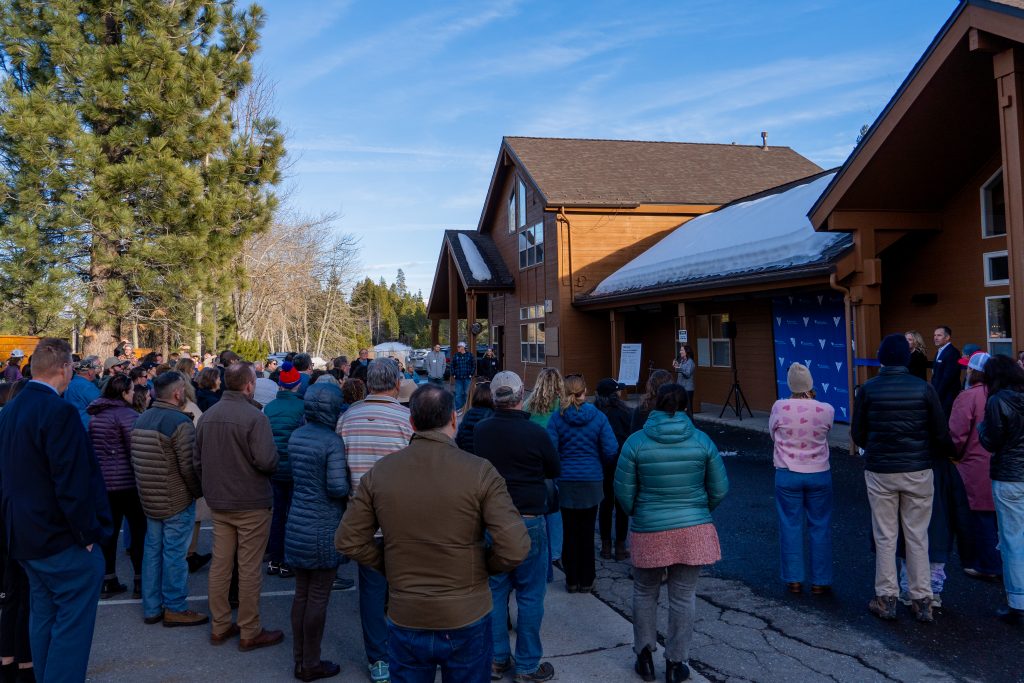
TRUCKEE, Calif. – On Friday, the Tahoe Truckee Homeless Action Coalition marked a milestone with a ribbon-cutting and open house for its one-year Navigation Center pilot in Truckee, a new resource designed to support residents experiencing homelessness with shelter, day services and case management.

The coalition announced the center’s target opening date as Feb. 25.

“Today, we should be proud of where we are, what we’ve accomplished and what this community made possible,” said Cindy Basso, founder of Fellowship of Compassion and TTHAC co-chair.

Tahoe Truckee Homeless Action Coalition announced the center’s target opening date as Feb. 25.

The center will be staffed 24 hours a day, seven days a week by Volunteers of America. It will offer six interim housing beds and 10 year-round shelter beds. The 10-person staff includes team members from Reno and the Truckee-Tahoe area. At least two staff members will be on site at all times.

“The weather forecast for the next week reminds me of the importance we have to safeguard our homeless from extreme weather,” said Jan Zabriskie , Town of Truckee Council Member and TTAHC co-chair. “That’s why we have a shelter here. It will assures stability and security for our homeless.”

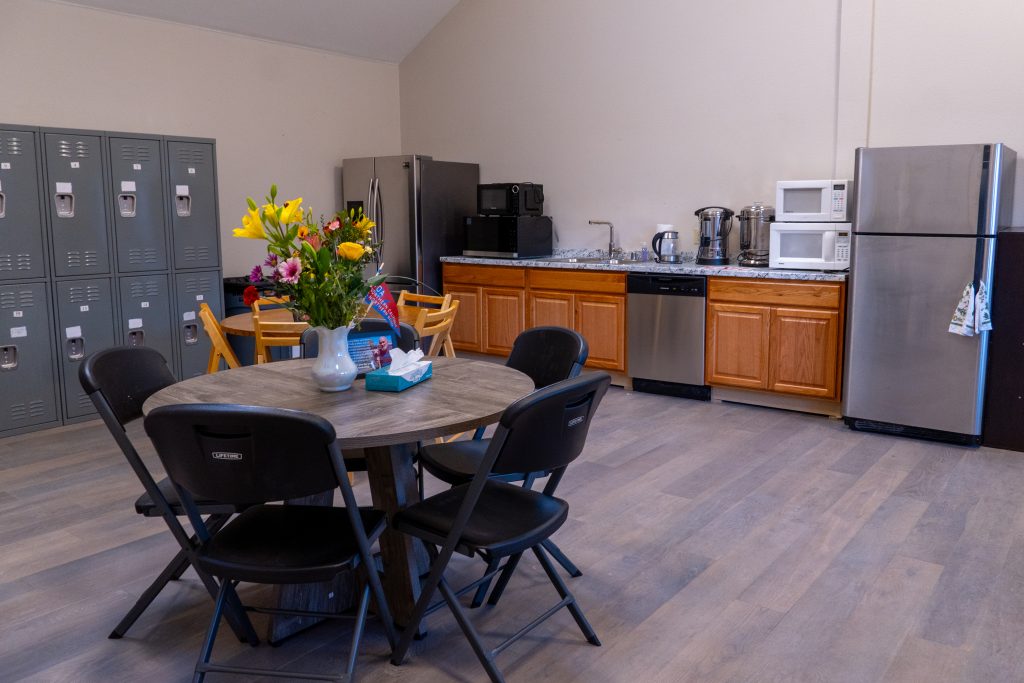
The Navigation Center’s common area.

During the open house, Shelter Manager Justin Jones walked attendees through the facility. He pointed out the front check-in station, where each person entering the building will be screened with metal detectors to prevent weapons, drugs, alcohol or other prohibited items from being brought inside.

Jones said the building’s layout was designed with safety in mind. Open space beneath bathroom stall doors allows staff to identify potential medical emergencies, such as someone fainting inside.

The main common area includes lockers adjacent to the kitchen, tables and shared amenities. Each resident will be assigned one locker and two tote boxes for personal belongings. Meals will be provided on site, with coordination through Meals on Wheels supplying a portion of lunches and dinners.

The Navigation Center will provide six interim housing beds and 10 year-round shelter beds.

Coalition leaders said the Feb. 25 opening represents a community-driven effort to address homelessness in Truckee through safety, dignity and comprehensive support services.

“My friend Ryan always says the human condition is non linear. It goes up, it goes down, it goes on a journey like all of us. This is a spot where people can find their next step in life,” said Hardy Bullock, District 5 Supervisor and TTHAC co-chair. “This is a place for food, for shelter, for justice support, wrap around services, substance use disorder counseling, therapy, all the things we all need every day in our lives but some people don’t have access to.”

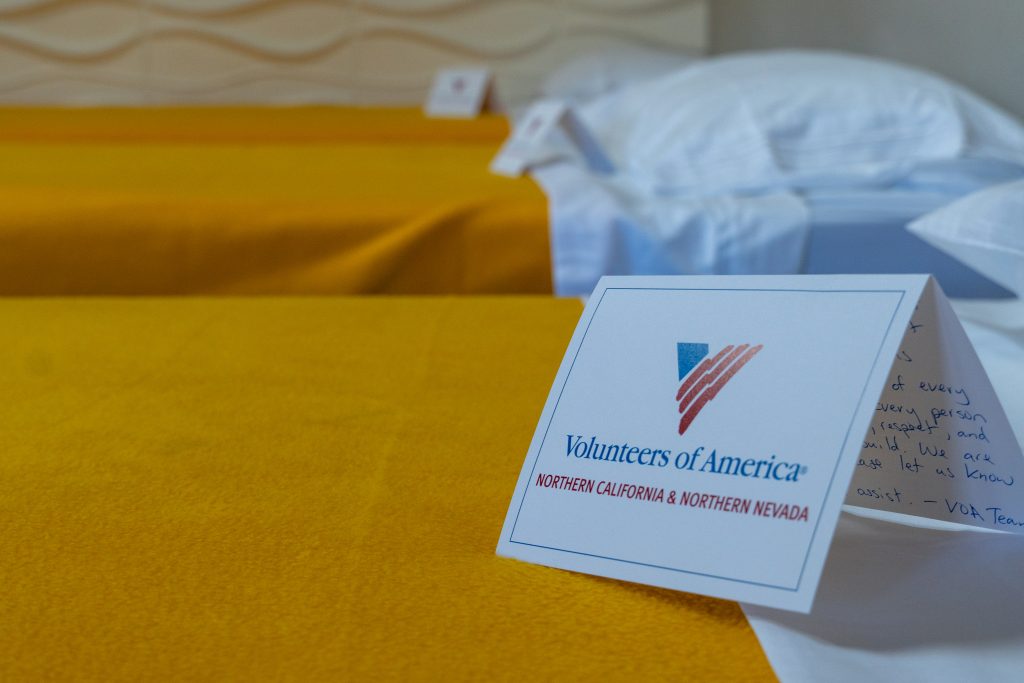
Each bed at the Navigation Center had a handwritten note.
< Back to Stories

Voices for Housing Episode 1: Mary

February 23, 2026

We are thrilled to launch Voices for Housing, a new campaign dedicated to sharing Tahoe Truckee housing stories from our community. Over the next several months, we will introduce you to local residents from diverse personal and professional backgrounds who all have a unique housing story to share.

We start with Mary, a local artist and retiree who explains her deep connection to Kings Beach. Her story is a perfect example of why housing for all matters for the creative heart of our community.

The Voices for Housing campaign is made possible thanks to a generous grant from the North Tahoe Community Alliance’s TOT-TBID Dollars at Work Program.

< Back to Stories

2026 Federal Housing Policy Review

January 27, 2026

Article by David Garcia, Terner Center for Housing Innovation, January 21, 2026

Link to article here.

After a surprising year of housing policy bipartisanship, lawmakers in Washington, DC are poised to continue pushing for housing supply and affordability solutions in 2026. At the same time, ongoing actions by the administration will continue to pose challenges to housing providers, developers, and the most housing insecure, while new and potentially forthcoming orders demonstrate a willingness to use executive power to address affordability concerns. As we head into an election year, there are several developments worth following in federal housing policy. This commentary previews the year ahead in Washington, DC.

Housing packages are poised to move forward in 2026.

By the end of 2025, both the House and Senate had advanced their own bipartisan bills to increase housing supply and promote affordability. And while the two packages (The ROAD to Housing Act in the Senate, and the Housing for the 21st Century Act in the House) have several unique and novel components, they also feature many overlapping and/or complementary features. Both packages have an opportunity to progress in the first half of this year before lawmakers turn their attention to the November election.

The ROAD to Housing Act, which passed out of the Senate Banking and Insurance Committee unanimously and was nearly passed into law as an amendment to the National Defense Authorization Act (NDAA),[1] contains several provisions that would have a positive impact on housing supply. These provisions include an expansion of the Rental Assistance Demonstration program (RAD) to preserve existing public housing,[2] reforms to existing federal loan products to support Accessory Dwelling Unit (ADU) financing,[3] and new programs leveraging existing federal dollars to promote more homebuilding in supply-constrained markets. As noted in a Terner Center commentary, the negotiation and advancement of ROAD to Housing represent a shift in how policymakers are approaching federal engagement on housing supply issues.

The Housing for the 21st Century Act advanced from the House Financial Services Committee on a vote of 50-to-1 just before the end of 2025. The Act includes provisions that are similar or identical to ROAD to Housing—for example, the Housing Supply Frameworks Act, reforms to the National Environmental Protection Act, and increases to Federal Housing Administration (FHA) mortgage insurance for residential multifamily construction. However, the proposed House legislation also includes a number of unique ideas that would support increases in housing supply and affordability. These include changes to the application of Build America, Buy America requirements for new homes using HOME Investment Partnerships Program (HOME) funding,[4] requirements that cities report on their progress toward reducing barriers to housing production as part of federal funding reporting, and an examination of how building code reforms could reduce the cost and complexity of homebuilding.

Lawmakers have limited time to move each package forward before members turn their attention to their respective 2026 election campaigns. In the Senate, ROAD to Housing must now be brought back to a vote of the full chamber. The next step for the Housing for the 21st Century Act will be a vote on the floor of the full House. Both could be advanced in the earlier part of the year, setting up a conference committee between the two chambers to send legislation to the president’s desk for signature into law.

The budget deal is poised to maintain funding for critical housing programs.

Senate and House members released their FY 2026 budget agreement on Tuesday, which generally maintains and even increases some funding for affordable housing and infrastructure programs, while increasing resources to vulnerable residents—despite earlier indications that those programs would face steep reductions. For example, lawmakers have proposed that the Community Development Block Grant (CDBG) Program and HOME both maintain the same funding levels as FY2025 after earlier facing nearly $1 billion less in last year’s budget proposal. In addition, $50 million is included for another round of the CDBG PRO HOME program, which provides support for localities pursuing land use and zoning reforms. Legislators have also proposed a funding increase over FY2025 levels for Housing Choice Vouchers (HCV), Project Based Rental Assistance, and Homeless Assistance Grants. Congress, which has been operating on a continuing resolution since November of last year, has until January 30 to vote on the full budget.

The budget deal also appears to include a solution for the Emergency Housing Voucher (EHV) program, which provides rental assistance to people experiencing or at risk of homelessness. EHV program funding was set to run out before the end of 2026. In the budget, $600 million is allocated to Tenant Protection Vouchers, which can be used to support current EHV holders. This is significant as our recent analysis notes that over 50,000 households nationwide are served through the program and would be at risk of losing that assistance.

The funding bill also includes language that would amend the U.S. Department of Housing and Urban Development (HUD’s) newly proposed guidelines for its largest homelessness program, the Continuum of Care (CoC) Program, which are currently suspended by a court order. HUD’s proposed funding criteria would have changed the CoC Program in many ways that would shift funding away from current permanent housing programs, potentially jeopardizing housing for 32,000 people in California. The bill would limit the extent to which HUD can make these shifts. It would also ensure funding continuity for current program awards that are scheduled to end prior to the next funding application process.

Executive Actions will continue to impact housing markets.

In addition to Congressional activity, the administration has signaled for several months that it has been working on Executive Actions to address housing supply and affordability, with President Trump saying in December that actions will include “some of the most aggressive housing reform plans in American history.”[5]

Statements from other administration officials signal that such actions could include the creation of new mortgage products and rule changes to allow for potential homebuyers to tap their 401(k) for down payments, as well as conditioning federal funds for states and cities on the adoption of policies to make it easier to build new homes. On January 20, President Trump also signed an Executive Order, which he alluded to in his remarks at the World Economic Summit, directing agencies to pursue initiatives aimed at curbing large institutional investor activity in the single-family home market. The Order would have the attorney general and the Federal Trade Commission review large acquisitions for anti-competitive practices and order other departments to promote sales to owner-occupants.

In addition, continued action on tariffs and immigration are likely to have a substantial impact on new supply. For example, multiple analyses by researchers and industry groups note that tariffs imposed or proposed in 2025 have the potential to increase the cost and uncertainty of new homebuilding. Increased deportation activity has also put a chill on residential construction labor supply, where immigrants comprise roughly a quarter of the labor force.[6] In California, more than two-thirds of California contractors cite skilled worker shortages as their top concern, and the state has faced a net loss of construction workers just in the last year.[7]

This year is likely to be consequential for housing affordability.

Polling going into this election year suggests that housing affordability will continue to be a consequential issue, and during campaign season, members of both parties are likely to want to showcase their efforts to advance meaningful legislation. Moreover, success on housing this year could set the table for even greater reforms in the next Congress and beyond. But for this momentum to continue into the next Congress, maintaining bipartisan support for housing solutions during what is likely to be a highly polarizing campaign will be critical.

Endnotes

[1] Lawmakers in Congress will often leverage “must-pass” bills to advance other priorities that are not relevant to the “must-pass” legislative vehicle. The NDAA is considered a “must-pass” bill to ensure funding for national defense.

[2] The RAD program allows public housing providers to rehabilitate existing units by leveraging private debt. We explored the potential of this program in a 2023 paper.

[3] A 2022 Terner Center paper explored the creation of loan products through existing federal programs specifically to provide homeowners with a broader selection of financing options.

[4] The Build America, Buy America Act (BABA) requires that all iron and steel, construction materials, and manufactured products used in federally funded infrastructure projects are produced in the United States. Affordable housing organizations have raised concerns that requiring affordable housing projects to adhere to BABA raises the cost of development.

[5] Samuels, B., & Manchester, J. (17 December, 2025). “Trump touts ‘warrior dividend’ checks, housing reform in address to nation.” The Hill. Retrieved from: https://thehill.com/homenews/administration/5654365-trump-primetime-address-housing-checks/

[6] National Association of Homebuilders. Concentration of Immigration in Construction Trades. Retrieved from: https://www.nahb.org/advocacy/industry-issues/labor-and-employment/immigration-reform-is-key-to-building-a-skilled-workforce/concentration-of-immigration-in-construction-trades

[7] The Home Builders Institute (HBI) Construction Labor Market Report. (2025). Home Builders Institute. https://hbi.org/wp-content/uploads/2025/10/Fall-2025-Final-Construction-Labor-Market-Report-Update.pdf; California Construction Workforce Trends 2025. (2025). ABLEMKR. https://ablemkr.com/california-construction-workforce-trends-2025/

STAY INFORMED AND STAY CONNECTED

Get important updates and timely information about workforce housing in our region.