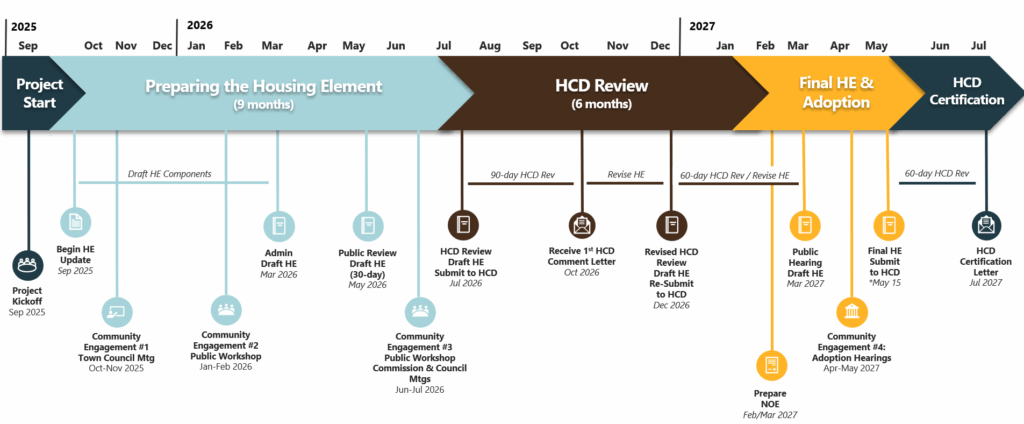
The Town of Truckee has Submitted the 2027-2035 Housing element to the State of California on July 9, 2026.
July 16, 2026
Housing Element Update Process Background
At the September 23, 2025 Town Council meeting, the Town Council kicked-off the 2027-2035 Housing Element Update process.
The Housing Element is one of seven required elements of a General Plan and the only element that is required to be certified by the State of California. The California Department of Housing and Community Development (HCD) reviews and certifies housing elements. A Housing Element is required to have the following components:
- Review of previous element
- Housing needs assessment based on the HCD’s analysis of the Regional Housing Needs Allocation (RHNA). The RHNA is a state-mandated process where the State quantifies the need for housing for each local jurisdiction; the Town is then tasked with ensuring that there is enough land zoned for the required residential density.
- Inventory and analysis of adequate sites to meet RHNA requirements
- Analysis of potential governmental and non-governmental constraints
- Housing policies and programs
- Quantified objectives
The Town of Truckee’s current 6th Cycle Housing Element, adopted in 2019, applies to the 2019-2027 planning period. In order to ensure compliance with State law, the Town is required to adopt and certify an updated Housing Element by May 15, 2027 for the 2027-2035 planning period (7th cycle). State law requires that HCD review and certify the Housing Element, which requires a 90-day HCD review period and potential revisions and subsequent 60-day reviews. The length of HCD’s review period requires that the Town begin work early on the update to ensure that the Housing Element is adopted by the May 15, 2027 deadline.
On June 25, 2025, the Town Council authorized a contract with Ascent Environmental (Ascent) to provide consulting services to help with drafting and adoption of the Housing Element.
Updated July 9, 2026
The Town of Truckee submitted the 2027-2035 HCD Review Draft Housing Element to the California Department of Housing and Community Development (HCD) for the State-mandated 90-day review of first draft submittals.
The Public Review Draft Housing Element was released on May 18, 2026, and the public comment period closed on June 17, 2026. During that period, the Town held a community meeting and open house on May 27, 2026, a special Planning Commission meeting on June 2, 2026, and a Town Council meeting on June 23, 2026. Following these meetings, the Town revised the Public Review Draft Housing Element in response to public comments and Town Council direction. The HCD Review Draft Housing Element was published on July 9, 2026, on the Town’s project website.
The Town did not receive any written comment letters during the public review period. However, public comments were received at the community meeting and open house and during the Planning Commission and Town Council meetings noted above. The Public Review Draft Housing Element was revised in response to those comments. The Town will continue to accept and review any comments received during the HCD review process and make any appropriate revisions to the draft Housing Element.
The following revisions were made since the public review draft:
- Program H-1.A – Updated the objective and timeline to support maintaining a 30% buffer.
- Removed the Truckee-Specific AMI program.
- Table HA-15 (Occupied Units by Tenure): Clarified that the totals in this table exclude units considered vacant.
- Table HF-1 (Progress Towards Meeting the 2019-2027 RHNA – Permitted Units Issued by Affordability): Calculations were corrected.
- References to the Olympics were changed to 1960 Olympics.
- Throughout the document, the term “pipeline projects” was changed to “projects in the entitlement pipeline” and the term was more clearly defined to mean projects that are approved by not constructed and projects that are under review.
- The approved and pending unit counts in the sites summary table and list of projects (Appendix HC-6) were separated.
- References to “Truckee Trails and Bikeways Master Plan” were updated to “Truckee Active Transportation Plan” to reference the future document the Town is working on, where appropriate.
- Minor typos were corrected.
Full Town of Truckee 2027-2035 HCD Review Draft Housing Element (PDF)
Individual Chapters
- Housing Element – HCD Review Draft (PDF) – This is the main policy framework.
- Appendix HA: Community Profile (PDF) – This section summarizes key population, household, employment, income, and housing market characteristics that shape housing demand and supply in the town, with attention to income level, tenure, and special needs groups.
- Appendix HB: Constraints (PDF) – This section reviews both governmental and non-governmental constraints to the maintenance and production of housing for all income levels. This section includes a comprehensive review of the Town’s Development Code requirements that apply to housing projects.
- Appendix HC: Site Inventory (PDF) – This section describes the Town’s assigned housing target, called the Regional Housing Needs Allocation (RHNA), and presents the Town’s strategy for how it will accommodate that need through the estimated residential capacity in the Town.
- Appendix HD: Assessment of Fair Housing (PDF) – This section is an assessment of fair housing conditions in Truckee as required by Government Code Section 65583 (c)(10). The analysis evaluates patterns related to segregation and integration, racially and ethnically concentrated areas of poverty, disparities in access to opportunity, disproportionate housing needs, how the sites inventory improves or exacerbates fair housing issues, and unique local factors.
- Appendix HE: Funding Resources and Energy Conservation (PDF) – This section describes the local, regional, State, and Federal funding resources that are available to support housing development and programs in Truckee and the ways the Town provides opportunities for energy conservation in residential development.
- Appendix HF: Past Performance (PDF) – This section summarizes major accomplishments made during the sixth cycle, highlights progress towards meeting special housing needs in the Town of Truckee, and provides an evaluation of sixth cycle housing element programs
- Appendix HG: Community Outreach (PDF) – This section summarizes the Town’s outreach efforts on housing and specific information on outreach conducted as part of the Housing Element effort.
- Appendix HH: Glossary (PDF) – This section defines terms found in the Housing Element and its appendices