< Back to News

Building Trust: A Faster Way to Preserve and Create Housing in Tahoe-Truckee

January 26, 2026

Sierra Sun, December 22, 2025

Link to story HERE

TRUCKEE, Calif. – You don’t need to follow the news or attend public meetings to feel the undercurrent of anxiety and frustration related to housing in the North Lake Tahoe-Truckee region. Renters are barely hanging on, long-time local families are moving out of the area and employers are struggling to find and retain workers. The housing crisis isn’t new, and while progress has been made in advancing housing solutions, the need continues to outstrip what our current tools can deliver.   

Over the last several years, Placer County and other local jurisdictions have taken important steps—dedicating staff capacity, advancing policy tools, investing in programs, and partnering regionally to increase housing options. That leadership matters. And at the same time, residents and employers are still asking the question that continues to surface across the region: What more can we do, and how do we move faster?

A little over a year ago, the Tahoe Housing Hub put out a call to the local community. They launched the ADU Accelerator Pilot program and invited homeowners to be part of the solution. The community stepped up in a big way. Staff from the Tahoe Housing Hub met with homeowners, walked their property, brought in engineers and planners, and tried to make the numbers pencil.

“It was incredible to see how many local people wanted to step up and be a part of the housing solution,” said Erin Casey, CEO of the Tahoe Housing Hub and Housing Tahoe.  “They were willing to share their personal space with other members of the community so that local workers and families could also have a place to call home in Tahoe.”  

What the pilot program made clear is that willingness is not the limiting factor—today’s costs and financing realities are. Programs like Placer County’s Launchpad incentives represent leadership and a commitment to housing. Yet even with those tools, many homeowners still face structural barriers: construction costs, financing constraints, insurance and utility realities, and the long-term requirements that often come with deed-restricted housing. In short: people want to help—and even with meaningful progress from local partners, many good-faith efforts still stall before they can become homes.

For years the North Lake Tahoe-Truckee community has been grappling with the same questions – what more can we do and how do we move faster to reach our housing goals?  From the early efforts of Mountain Housing Council to programs like the ADU Accelerator and Launchpad, many ideas have been tried, each moving the conversation forward. The reality is that building in mountain communities is complex and expensive—and those pressures have intensified in recent years. At the same time, existing housing continues to sell at prices unattainable for many local workers and families.

That’s where Housing Trust Tahoe comes in – a new mechanism to immediately preserve existing housing and add units on a small scale, while working alongside local jurisdictions and regional partners. As a 501(c)(3) charitable organization, Housing Trust Tahoe is poised to acquire and preserve existing homes, accept donations of land or property, and leverage private dollars from employers, philanthropy, and individual donors alongside public investment. That means a homeowner or business who wants to help has more than one path: they can build, they can sell or donate a home or a lot, or they can contribute financially to keep naturally affordable housing in local hands.

Housing Trust Tahoe isn’t just “another nonprofit.” It is the culmination of years of community energy, leadership and urgency focused on providing homes for our neighbors – the people who teach our children, serve our food, plow our roads, and care for our elders. On December 9, 2025, the Placer County Board of Supervisors approved $500,000 to support the formation of Housing Trust Tahoe which will develop processes and feasibility assessment tools for property acquisition and launch land/housing donation campaign.

Housing Trust Tahoe now has a new call to action for the local community. Do you have a home or an empty lot that you’d like to donate in exchange for a tax deduction? Do you have resources—financial or otherwise—that you want to put to work locally? Housing Trust Tahoe is ready to partner with the community to purchase units and turn donations into homes for local workers and families.

“We are already in the process of accepting our first donation which will directly translate into homes for local workers. Housing Trust Tahoe is a culmination of all those years of energy, frustration and urgency that we’ve felt for so long. We finally have a mechanism to do more and do it quickly,” says Casey.
< Back to Stories

Creating a Housing Trust – Public Comments

December 17, 2025

< Back to Stories

Housing 101: Why Every California Community Must Plan for Housing

October 16, 2025

The State Sets the Goals – Communities Decide How to Get There

Across California, every city and county is legally required to plan for housing at all income levels. This isn’t optional — it’s part of state housing law that dates to 1969, when California began requiring local governments to adopt what’s known as a Housing Element as part of their General Plan.

The state’s goal is simple: ensure that communities plan for enough homes for residents of all income levels — from very low-income families to higher earners. To do this, the California Department of Housing and Community Development (HCD) determines the total number of homes the state needs. That number is then divided among 28 regional planning areas and allocated to each city and county through a process called the Regional Housing Needs Allocation (RHNA).

Each community captures these state-assigned housing goals in a document called the Housing Element. It’s part of the community’s General Plan and lays out how the town or county will meet its share of housing needs — including zoning updates, land use policies, and programs to support housing at different income levels. Every city and county in the state is required to update their housing element on a seven-year cycle.  

Why the State Is Taking Housing Seriously

In recent years, California has taken a much more aggressive approach to enforcing housing laws. Cities and counties that fail to adopt a compliant housing element now face penalties and loss of control over local zoning decisions. One major consequence is the “builder’s remedy,” which allows developers to bypass local zoning restrictions if a jurisdiction’s housing element is out of compliance. That means if a town or county doesn’t meet state requirements, it loses some of its ability to decide what gets built and where.

Truckee’s Turn to Update Its Housing Element

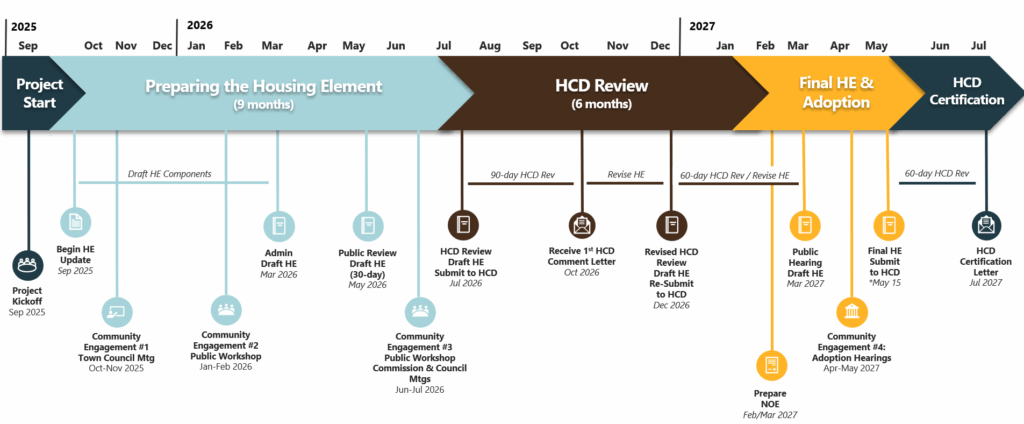
It’s crunch time for the Town of Truckee to update the town’s Housing Element and get it certified by HCD. The town has about a year and a half to update the existing housing element, allow for a lengthy review process and work with HCD to achieve certification.

During Truckee’s last update, adopted in 2019, the town was required to create planning and regulatory systems for 775 housing units. This time around, based on current data from the RHNA, Truckee must identify development sites, review and update policies, zoning and regulations (if needed), create specific goals, objectives and programs for the preservation and development of 1,534 units – more than double requirement from the previous cycle.  

What Does This Mean to You?

Community input and participation is built into the housing element update process, and it is your chance to help guide where new development should occur and what it should be. It’s important to note that the Town of Truckee is required by state law to create a housing element that removes government constraints and provides a clear framework for development of the 1,534 units. The community can’t say they just don’t want 1,534 more units, but it can be a part of the decision-making process for how and where those units are built.

Solutions to Meet Housing Needs

The actual number of units constructed depends on market demand, cost, financing and other economic considerations. This means that even though there is a great need for housing, new development is never the only solution. An often-overlooked strategy when developing a jurisdiction’s housing element is NOAH – or Naturally Occurring Affordable Housing. At the Tahoe Housing Hub, we believe NOAH should be prioritized as a critical part of every housing element. With the cost of new construction so high, NOAH provides a way for local governments or non-profits to purchase existing housing and deed restrict it in perpetuity to serve the local population.

The Tahoe Housing Hub is currently expanding to add a 501(c)3 non-profit component of the organization that will be able to purchase NOAH units, make necessary upgrades and permanently preserve critically needed housing for the local workforce, seniors and families in our community.

How to get involved:

The Town of Truckee began updating the housing element in September 2025, and is planning to provide initial information during a Town Council meeting sometime in late October or November. More information about the town’s housing element update process can be found here. All jurisdictions in the state are required to create and update their housing element. Placer County and El Dorado County’s current housing elements run through 2029.  Nevada County’s housing element runs through 2027, so Nevada County will likely start their update process soon. The chart below outline’s the Town of Truckee’s timeline for completing the Housing Element.

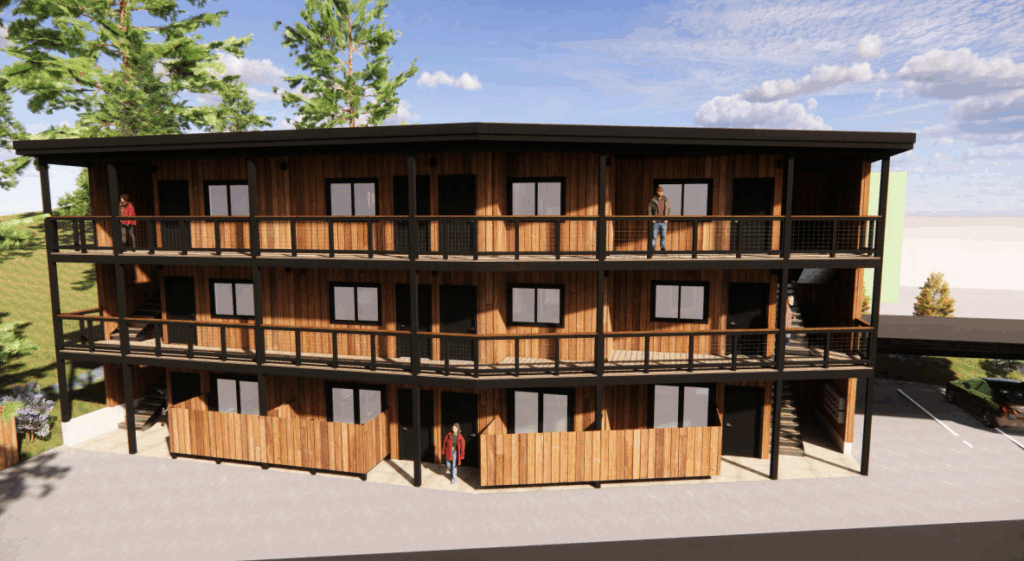
Artist rendering of Edmunds Lofts, a 12-unit workforce housing project located on Edmunds Drive near Meadowood Park in Truckee.

STAY INFORMED AND STAY CONNECTED

Get important updates and timely information about workforce housing in our region.