< Back to Stories

Article: Why State Housing Reform is Failing (and What We Can Do About It)

January 26, 2026

In this article by Edward Erfurt, published in Strong Towns on December 2, 2025, the author breaks down the reasons why building infill housing like ADUs is so difficult. The complexities and risk profiles for individual homeowners building an ADU are vastly different than they are for large developers. This article provides a great explanation of why.

Link to full article HERE.

Across the country, state legislatures are taking bold steps to make more housing possible. Parking mandates are being rolled back. Accessory dwelling units (ADUs) are being legalized. Entire housing types that were prohibited for decades are now being allowed by right.

For many communities, these changes feel like long-overdue progress. Yet even in the most supportive communities, almost nothing is getting built.

After all the effort, all the hearings, all the debate and negotiation, the number of new units emerging from these reforms is at best a trickle. As I travel across the country talking to communities, these local governments are asking the same question: Why?

The answer reveals something deeper than zoning.

The Paradox of Legalizing Something You Can’t Actually Do

Legalization is the first step, but it is not the ecosystem. I was in Flagstaff, Arizona when the local city council had declared a housing emergency. City staff shared how they wanted to see ADUs built as an option to address the housing crisis. The community was on board politically, because they expanded the applicability of ADU to cover the entire city. But “allowed by right” didn’t translate into “possible in practice.” Builders still couldn’t make the projects work. They could not make these work not because the idea was wrong, but because there’s no broader system to support small-scale development in place.

Our approach to zoning and adoption of codes have left communities with an inability to take action. Over the years, permitting processes grew more complicated, layers of review multiplied, and neighbor veto points cemented themselves into procedure. On top of it all, the procedures in place aren’t proportional to the project. The smallest of projects must navigate systems designed for the largest of developments. A 600-square-foot backyard cottage must comply with the same development standards, permitting submission requirements, and timelines as a 2,500-square-foot house on a one-acre lot.

This tangle of requirements occurs all before we reach the financing system, where nearly every available tool is designed for one thing: standardized, federally backed, single-family houses on large lots. These are the mortgages that banks can bundle and sell on secondary markets, at very low risk. Builders must stack more complicated, and expensive financing that is not readily accessible to all. 

State law can declare that small backyard cottages are legal. But unless cities can review them, permit them, and builders can finance them, legalization will remain largely symbolic.

When State Reform Crashes Into Local Capacity

This gap between the state’s mandate and the city’s ability to carry it out is where the real struggle begins. Cities often default to their only familiar process, so what we’ve seen is that they’ll apply the same permit process for a small ADU as they would a multifamily building. Cities use the permits and processes they know because they have no other smaller template, or worse, they create an even more complicated process. What should be the lowest risk investment, quickly becomes overly complicated and far more risky. That shift in risk matters. Small builders or homeowners are working in the thinnest of margins and uncertainty and risk increases costs.

What looks like a simple option for affordable housing on paper quickly becomes quite unintentionally the most expensive housing to deliver in the city.

Imagine a homeowner walks in, hoping to build a cottage no larger than a shed in their backyard, or convert their garage into an apartment. They’re handed the thick binder of requirements to address all of the unknowns that could occur. The natural reaction of municipal staff when they face uncertainty is to demand more. So an exhaustive and detailed process is initiated to root out and eliminate every possible failure or conflict. The result is a tangle of forms and submittals that imply that perhaps the applicant shouldn’t attempt this after all.

A builder deciding between a modest cottage in an established neighborhood and a large single-family home on the edge of town will likely choose the easier path. When both projects offer the same financial return, people understandably choose the one with fewer headaches. Cities unintentionally push small-scale builders away, not through policy, but through friction.

A Case Study in What Works: Tallahassee’s Breakthrough

We’ve seen the opposite, too. Tallahassee, Florida, had very few ADU permits. Only a handful of persistent builders attempted them. Rather than defending their process, city staff sat down with those builders and listened to learn where there were tangles and friction. They asked where the bottlenecks were. They investigated every confusion point, every unnecessary submittal, every erroneous requirement, and sought out conflicting requirements. Then they made small adjustments: clarifying intent, adjusting standards to align with existing zoning, and making procedures proportional to the scale of the application.

The result? An exponential increase in permits.

This wasn’t a statewide mandate. It wasn’t a massive rewrite. It was staff learning the scale of the work and responding proportionally. They built the local ecosystem necessary for incremental housing to succeed.

What State Mandates Can’t Do

A mandate can change the zoning, but it cannot:

  • Teach staff how to right-size their review.
  • Build trust between cities and local builders.
  • Reform decades of overengineered building codes designed for the biggest projects.
  • Create financing tools that fit the scale of a backyard cottage rather than a cookie cutter suburban home.
  • Form local partnerships between small banks and small developers.
  • Reduce the cultural fear of neighborhoods evolving again.

These changes must be made locally. They are the “ecosystem” of incremental developers, contractors, plan reviewers, lenders, and neighbors. This is why state reforms so often underdeliver: the structure changed, the permissions changed, but the systems never adapted.

What Cities Can Do Right Now

Cities have more control in this process than they think. And small steps matter because ADUs are the lowest-risk housing type a city can allow. They can start by asking three questions:

1. How can we reduce risk for the smallest projects?

Lowering risk lowers cost. That may mean creating a simplified permit, a predictable review timeline, or a small-housing checklist.

2. Are our fees and standards proportionate to the scale of the work?

Many cities charge permit fees for new construction. Waivers or scaled fees can make incremental housing feasible.

3. What local financing tools already exist—and who can we partner with?

Small banks understand local risk better than national lenders. Cities can convene them, share case studies like California’s ADU financing programs, and begin adapting those models.

This is how we localize financing: not through subsidies, but through relationships.

A Call for a More Human Approach

We also need to demystify these units for our communities. At Strong Towns, we’ve learned that people respond far more to stories than policy.

When we talk about who actually lives in back yard cottages we share stories of grandparents staying close, adult children returning home, caregivers helping a senior in place. We also do not use planning acronyms because ADU sounds more like a disease than a home. These are familiar stories that are relatable. Incremental housing is not a radical transformation. It’s a return to the adaptable neighborhoods we built for generations.

But helping people rediscover that truth starts with listening, and this conversation starts best at the most local level at city hall.

< Back to News

New housing trust launches to preserve workforce housing in North Lake Tahoe, Truckee

January 26, 2026

Story by Maria Palma, KUNR Public Radio, December 18, 2025

Link to story HERE

Published December 18, 2025 at 12:04 PM PST

Downtown Truckee
Downtown Truckee

Housing affordability continues to strain workers and families in the North Lake Tahoe–Truckee region, where rising costs are pushing longtime residents out of the area.

Earlier this month, the Placer County Board of Supervisors approved $500,000 to support the formation of Housing Trust Tahoe, a nonprofit that will work alongside the Tahoe Housing Hub to preserve and expand workforce housing. The funding will be used to support staffing, legal setup, property evaluation, and outreach efforts related to housing and land donations.

“The $500,000 isn’t to make any particular purchases,” said Tim Cussen, a Tahoe housing specialist with Placer County. “It goes toward diligence for future property acquisitions or donations. We’re looking at preserving workforce housing, and maybe even adding units when possible.”

Housing Trust Tahoe builds on years of local housing efforts, including the Tahoe Housing Hub’s ADU Accelerator Pilot Program.

“It was incredible to see how many local people wanted to step up and be a part of the housing solution,” said Erin Casey, CEO of the Tahoe Housing Hub and Housing Trust Tahoe. “We finally have a mechanism to do more, and do it quickly.”

As a 501(c)(3) nonprofit, Housing Trust Tahoe can acquire and preserve existing homes, accept donations of land or property, and combine private and public funding to help keep housing affordable for local workers.

Leaders say the organization is already in the process of accepting its first property donation.

< Back to Stories

Housing 101: Why Every California Community Must Plan for Housing

October 16, 2025

The State Sets the Goals – Communities Decide How to Get There

Across California, every city and county is legally required to plan for housing at all income levels. This isn’t optional — it’s part of state housing law that dates to 1969, when California began requiring local governments to adopt what’s known as a Housing Element as part of their General Plan.

The state’s goal is simple: ensure that communities plan for enough homes for residents of all income levels — from very low-income families to higher earners. To do this, the California Department of Housing and Community Development (HCD) determines the total number of homes the state needs. That number is then divided among 28 regional planning areas and allocated to each city and county through a process called the Regional Housing Needs Allocation (RHNA).

Each community captures these state-assigned housing goals in a document called the Housing Element. It’s part of the community’s General Plan and lays out how the town or county will meet its share of housing needs — including zoning updates, land use policies, and programs to support housing at different income levels. Every city and county in the state is required to update their housing element on a seven-year cycle.  

Why the State Is Taking Housing Seriously

In recent years, California has taken a much more aggressive approach to enforcing housing laws. Cities and counties that fail to adopt a compliant housing element now face penalties and loss of control over local zoning decisions. One major consequence is the “builder’s remedy,” which allows developers to bypass local zoning restrictions if a jurisdiction’s housing element is out of compliance. That means if a town or county doesn’t meet state requirements, it loses some of its ability to decide what gets built and where.

Truckee’s Turn to Update Its Housing Element

It’s crunch time for the Town of Truckee to update the town’s Housing Element and get it certified by HCD. The town has about a year and a half to update the existing housing element, allow for a lengthy review process and work with HCD to achieve certification.

During Truckee’s last update, adopted in 2019, the town was required to create planning and regulatory systems for 775 housing units. This time around, based on current data from the RHNA, Truckee must identify development sites, review and update policies, zoning and regulations (if needed), create specific goals, objectives and programs for the preservation and development of 1,534 units – more than double requirement from the previous cycle.  

What Does This Mean to You?

Community input and participation is built into the housing element update process, and it is your chance to help guide where new development should occur and what it should be. It’s important to note that the Town of Truckee is required by state law to create a housing element that removes government constraints and provides a clear framework for development of the 1,534 units. The community can’t say they just don’t want 1,534 more units, but it can be a part of the decision-making process for how and where those units are built.

Solutions to Meet Housing Needs

The actual number of units constructed depends on market demand, cost, financing and other economic considerations. This means that even though there is a great need for housing, new development is never the only solution. An often-overlooked strategy when developing a jurisdiction’s housing element is NOAH – or Naturally Occurring Affordable Housing. At the Tahoe Housing Hub, we believe NOAH should be prioritized as a critical part of every housing element. With the cost of new construction so high, NOAH provides a way for local governments or non-profits to purchase existing housing and deed restrict it in perpetuity to serve the local population.

The Tahoe Housing Hub is currently expanding to add a 501(c)3 non-profit component of the organization that will be able to purchase NOAH units, make necessary upgrades and permanently preserve critically needed housing for the local workforce, seniors and families in our community.

How to get involved:

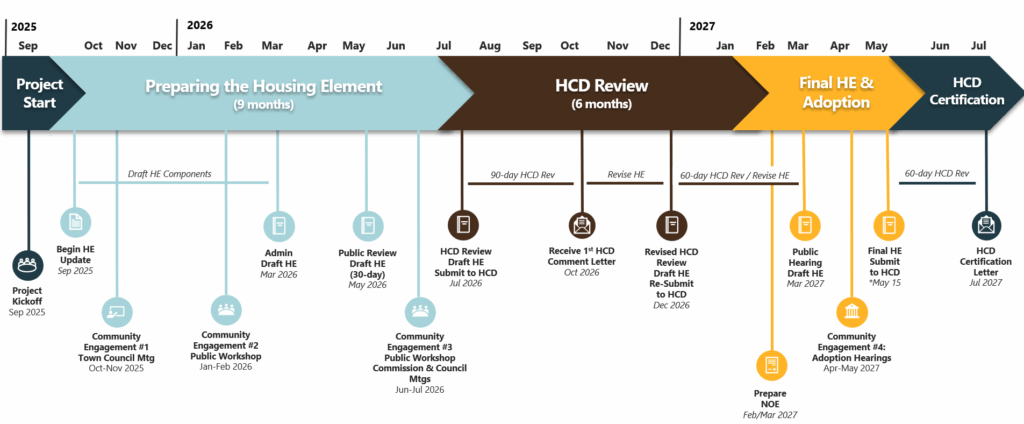
The Town of Truckee began updating the housing element in September 2025, and is planning to provide initial information during a Town Council meeting sometime in late October or November. More information about the town’s housing element update process can be found here. All jurisdictions in the state are required to create and update their housing element. Placer County and El Dorado County’s current housing elements run through 2029.  Nevada County’s housing element runs through 2027, so Nevada County will likely start their update process soon. The chart below outline’s the Town of Truckee’s timeline for completing the Housing Element.

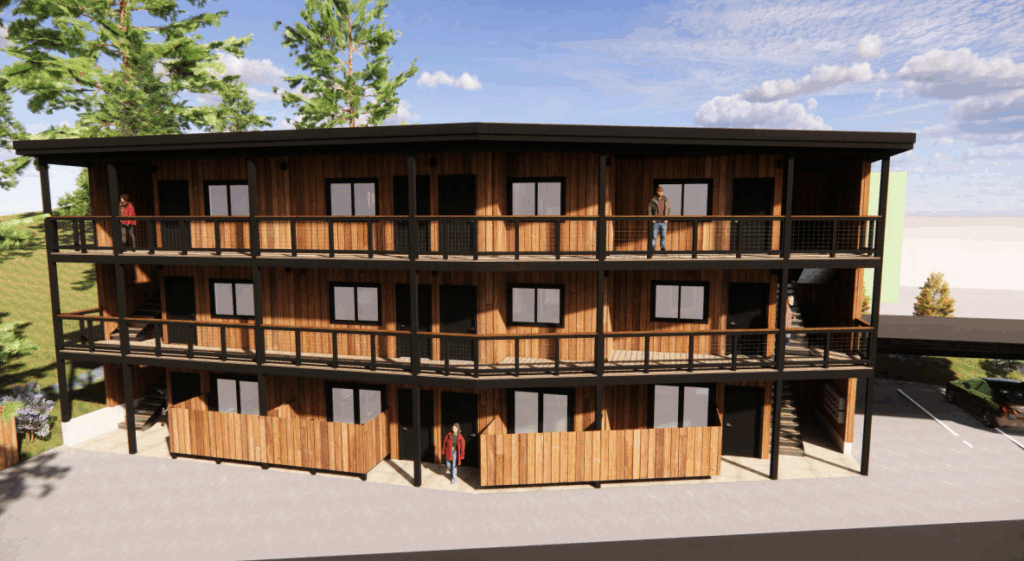
Artist rendering of Edmunds Lofts, a 12-unit workforce housing project located on Edmunds Drive near Meadowood Park in Truckee.

STAY INFORMED AND STAY CONNECTED

Get important updates and timely information about workforce housing in our region.