< Back to Stories

Housing 101: Breaking Down California’s 2025 Housing Legislation

September 18, 2025

The California Legislature ended its 2025 session over the weekend with a slew of new housing initiatives aimed at reducing costs and speeding up the process to build housing. The legislature passed a total of seven bills that now sit on Governor Newsom’s desk. He has until October 12 to sign or veto the bills.

**It’s important to remember that since development in the Lake Tahoe Basin is governed by the Tahoe Regional Planning Agency under a bi-state compact, state law sometimes doesn’t immediately apply or is modified within in the Tahoe Basin.  Here’s a breakdown of the legislation:

Speeding Up Housing Approvals

  • AB 253 – The housing “shot clock” speeds up approvals by allowing home builders to hire a licensed third-party reviewer if local agencies can’t complete a permit review within 30 days.
  • AB 1308 – Creates another “shot clock,” this time for inspections. Jurisdictions must complete final inspections within 10 days for new residential buildings or additions of 1–10 units.

Expanding Housing Opportunities

  • AB 79 – Makes it faster and easier to build multifamily housing near transit stops, with requirements tied to the type of transit, its frequency, and the distance from housing to transit.
  • AB 1061 – Extends the provisions of SB 9 (2021)—which allows for lot splits and duplexes in single-family neighborhoods—to historic districts if existing historic structures are not altered or demolished.

Supporting ADUs and JADUs

  • SB 9 (2025) – Despite sharing the same number, this is different from SB 9 (2021). It reforms ADU ordinances by requiring local governments to bring them into compliance with state law and gives HCD the authority to void any local ordinances that create barriers to ADU construction.
  • AB 1154 – Clarifies rules for Junior ADUs (under 500 sq. ft.) by creating a unified set of standards, resolving confusion from overlapping rules, and making approvals faster and easier.

Making Housing More Accessible

  • AB 413 – Requires the Department of Housing and Community Development (HCD) to translate key state housing guidelines and handbooks into the non-English languages commonly spoken in California, so more homeowners and builders can understand their housing options.

Local Spotlight: Tahoe Basin

Closer to home, the Placer County Planning Commission recommended approval of the Tahoe Basin Area Plan Phase 2 Housing Amendments Their recommendation now moves to the Placer County Board of Supervisors, who will make a final vote on the Amendments later in 2025.

The Phase 2 Amendments apply to housing projects that are 100% deed-restricted and located within town centers in Kings Beach, Tahoe City and other areas zoned for multifamily housing and allow for greater flexibility related to building height, density and parking.

These new housing bills highlight the state’s ongoing efforts to address housing challenges by focusing on faster approvals, expanded opportunities, and clearer rules. Locally, we’re working closely with the Tahoe-Truckee Workforce Housing Agency, which has partnered with Sierra Business Council on state-level housing policy initiatives. You can track statewide legislation and get more in-depth analysis here.

This collaboration helps ensure our region’s housing needs are represented in Sacramento. We’ll also continue to share updates as these laws take shape and as local changes—such as the Tahoe Basin amendments—move forward. By staying informed, our community can better understand the evolving housing landscape and the opportunities ahead.

< Back to Stories

Housing in Tahoe/Truckee on the Regional and Statewide Radar

August 12, 2025

In July, the Tahoe Regional Planning Agency (TRPA) hosted the second round of community workshops for the Tahoe Living: Cultivating Community, Conserving the Basin project. At the North and South Shore meetings, more than 100 community members and workforce housing stakeholders provided input on fundamental changes to the permitting process for affordable housing projects and accessory dwelling units. TRPA has been hosting a series of bi-lingual workshops, webinars and working groups for the second phase of Cultivating Community, Conserving the Basin. The goal of this multi-year project is to create meaningful policy changes that can make housing more accessible in the Tahoe Region while maintaining and improving environmental protections. You can learn more about the project objectives, timeline, and how to get involved at tahoeliving.org.

Also in July, the Tahoe Truckee Community Foundation hosted Tomiquia Moss, California Secretary of Business, Consumer Services, and Housing for a dynamic conversation with local housing agencies and organizations including the Tahoe Housing Hub, Placer County, Town of Truckee and the Tahoe Truckee Workforce Housing Agency. Local housing leaders articulated Tahoe Truckee’s full housing landscape, from rural homelessness to workforce housing gaps and rising fire insurance costs to where State policy can leave mountain communities behind. The Secretary and her team came to learn about Tahoe-Truckee’s regional housing and forest-to-housing efforts as part of a greater, statewide effort hosted by the League of California Community Foundations.

< Back to Stories

Housing 101: ADU Lessons Learned

July 16, 2025

What Homeowners Should Know Before Building

ADUs Are Hard, But Prefabs May Offer a Solution

When we launched the Tahoe Housing Hub’s ADU Accelerator Pilot Program in late 2024, we were ambitious. We set out to support the construction of 20 accessory dwelling units (ADUs) in two years and build momentum from there.

The response was strong – over 100 people joined our interest list prior to launching the program, and more than 60 homeowners have since completed applications. Its clear residents want to be part of the solution but building ADUs in the Tahoe-Truckee region is anything but easy.

A year in, we’ve learned the same challenges that make construction difficult in the Tahoe-Truckee region—high costs, short building seasons, and a complicated permitting process—also apply to ADUs. Building a small unit doesn’t necessarily mean small challenges.

In response, we’ve had to get creative – exploring new approaches to construction, design, financing, and permitting in hopes of making ADUs more feasible for homeowners.

Traditional Construction vs. Prefab

The cost of traditional ‘stick-built’ construction cost is simply too high for most people to build an ADU. To address this, we’ve researched financing options, local housing incentive programs, and explored prefab and modular construction companies to find a low-cost solution to our high snow load environment.

Prefab and modular units are built off-site in a controlled environment, then transported and installed on your property. The quality is excellent, energy efficient, and often incorporates sustainable design and construction materials.  They can also reduce construction time and minimize weather delays. You can get anything from a 450 to a 1200 square foot ADU built this way, and the costs are significantly less than traditional construction.

If you’re considering prefab, it’s essential to do your homework. Some companies don’t have experience building in our region, and many models aren’t designed to meet our snow load or energy efficiency requirements. Ask if they’ve installed ADUs in the Tahoe region, whether their models are engineered to meet local codes, and if they can provide references from similar mountain climates. Also, be sure to compare the total cost of the project—not just the base price of the unit. Site work, foundation, utility hookups, and permits can significantly increase the final price.

The Town of Truckee has more detailed information on the different types of prefab ADUs, links to snow load requirements and local building and design criteria. Their site also provides links to several prefab companies. It’s important to note that the town’s prefab company list is informational only, and some of those companies may not be able to provide a product that meets the required snow loads in our area.

How the ADU Accelerator Can Help

If you are interested in a prefab ADU, please reach out to us. We are currently developing a list of prefab ADU companies with products that meet our region’s snow load requirements that we hope will help homeowners as they explore prefab ADU options.

Every ADU that is built in conjunction with our ADU Accelerator Pilot Program provides a home for a local worker. As we continue to learn what works—and what doesn’t—we’re focused on helping homeowners navigate the complexities of building in this region. Program participants receive free technical assistance as they navigate the permitting and construction process. We also cover all or some of the cost of additional pre-construction services like site surveys, land use planning, engineering and design.

Homeowners who participate in the program agree to rent their ADU to a local worker and can choose two different options: rent at market rate for 5 years or rent at a lower rate set by HUD for 3 years. The ADU Accelerator program is made possible by a grant from the Martis Fund and the North Tahoe Community Alliance’s TBID/TOT Dollars at Work Program. For more information visit www.tahoehousinghub.org.

< Back to Stories

Housing 101: 700 on the Waitlist – Tahoe’s Affordable Housing Reality

June 18, 2025

The complexities surrounding affordable housing often lead to confusion. Terms like workforce, achievable, and affordable housing are used interchangeably, yet each describes a critical part of the region’s housing challenges. At its core, affordable housing simply means having enough homes at prices accessible to all community members, regardless of income.

Mountain Housing Council, a program of the Tahoe Truckee Community Foundation, has been working since 2017 to identify and define who in our community needs housing, if and what the barriers are to affordability, and how our region can address the problem. Their research consistently reveals significant unmet housing needs. The latest report from 2023 identifies a startling gap—approximately 8,200 housing units are urgently required across various income levels, family sizes, and housing types. These comprehensive reports provided the first real data on the range of unmet housing needs in our region and spurred urgent discussion and action within our communities. The work we do at the Tahoe Housing Hub is a direct result of the groundwork laid by the Mountain Housing Council.

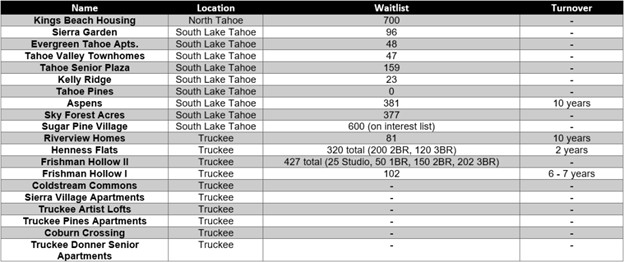
For many residents, these numbers seem abstract. However, a recent Tahoe Daily Tribune article vividly illustrates the depth of this crisis through real-world implications. It reports that nearly 700 people are currently on waitlists for the limited number of available affordable housing units—homes specifically priced for those earning 80% or less of the area median income (AMI). The article further notes infrequent turnover, highlighting how rarely new opportunities become available.

It’s natural to question, “Do we really need more affordable units in Tahoe?” Yet, the waitlist data provides a clear and direct indication that the demand is very real. Addressing this critical housing shortage is fundamental for maintaining the strength and stability of our community.

The Tahoe Housing Hub continues working actively to address these housing needs, advocating for solutions while helping to increase the number of affordable units available to residents through the ADU Accelerator program. This important work is part of a broader collaborative effort across the region involving partners such as Placer County, Town of Truckee, Truckee Tahoe Workforce Housing Agency (TTWHA), and the Mountain Housing Council (MHC), among others. Together, these groups demonstrate a regional commitment to resolving our housing challenges.

*Housing Chart Source: Tahoe Daily Tribune. The City of South Lake Tahoe requires property managers to keep track of turnover and wait lists. The data is not available for many of the properties located in Truckee.

< Back to Stories

Housing 101: Deed Restrictions Explained

May 21, 2025

Housing 101: Deed Restrictions Explained

If you’ve been part of a housing conversation lately—at a public meeting or chatting with neighbors, chances are the term “deed restriction” has come up. It may sound like legal jargon, but it’s a tool that has been used for decades to help guide how housing is used and who it serves.

What Is a Deed Restriction?

A deed restriction is a legally binding agreement that limits certain aspects of how a property can be used. It “runs with the land,” meaning it stays in place when the property is sold or transferred. The two most common types are:

  1. Income-Based Restrictions limit who can rent or buy based on income – typically for those making less than the average income within a community. This model is used mostly for rental housing, where rents are limited to ensure households spend no more than 30% of their net income on housing.
  2. Local Employment or Residency- Based Restrictions (aka “Local-Worker Restriction) prioritize full-time workers or residents of a community. These may include higher income caps and support the “missing middle”—those who earn too much for traditional affordable housing but still can’t afford market-rate prices.

Why They Work – and Where They’re Used

In North Lake Tahoe-Truckee, deed restrictions have been part of the housing strategy for more than 20 years. Projects like Frishman Hollow, Sierra Village Apartments and Kings Beach Housing provide deed restricted for sale and rental housing for a range of local workers: teachers, first responders, ski lift operators, restaurant workers and more.

Other communities, like Vail Colorado, have expanded these efforts. Vail’s InDEED program offers up to $200,000 to homeowners in exchange for a local worker deed restriction – without resale limits or income caps. This model has preserved over 165 homes and demonstrates that flexible programs can work. More examples are featured in the 2023 Workforce Housing Report.

Not One-Size-Fits-All—Especially for ADUs

Deed restrictions aren’t one-size-fits-all, and in some cases, applying them too rigidly can backfire. That’s especially true for homeowners building ADUs. Large scale housing developers might be willing to take on 55-year deed restrictions, but expecting an individual homeowner to do the same can actually discourage participation.  

That’s why local programs are beginning to explore more flexible deed restriction models: shorter terms, rent caps, or incentive payments that still support local housing without placing too much burden on homeowners.

Resale Value for Deed Restricted Homes

For many homebuyers considering a deed-restricted property, it’s natural to wonder how a restriction might affect future resale value. Many deed restriction programs are designed to preserve affordability while also allowing homeowners to build modest, meaningful equity over time. For example, in some cases, resale prices for deed restricted homes are tied to changes in the area’s median income. In other cases, homeowners can sell their property at market value, if the buyer is a local worker.

A Proven Tool—When Applied Thoughtfully

Deed restrictions have been a proven part of housing strategies in communities across the country but like any tool, they aren’t one-size-fits-all. The most successful programs are those that apply deed restrictions where they work best—and are willing to modify or adapt them in situations where they may not. For a deeper look at how deed-restricted homeownership works and the different ways communities apply it, check out some of these resources.

STAY INFORMED AND STAY CONNECTED

Get important updates and timely information about workforce housing in our region.