Truckee Navigation Center Unveils Facility Ahead of Feb. 25 Opening
February 24, 2026
Sierra Sun, February 15, 2026 by Petra Molina
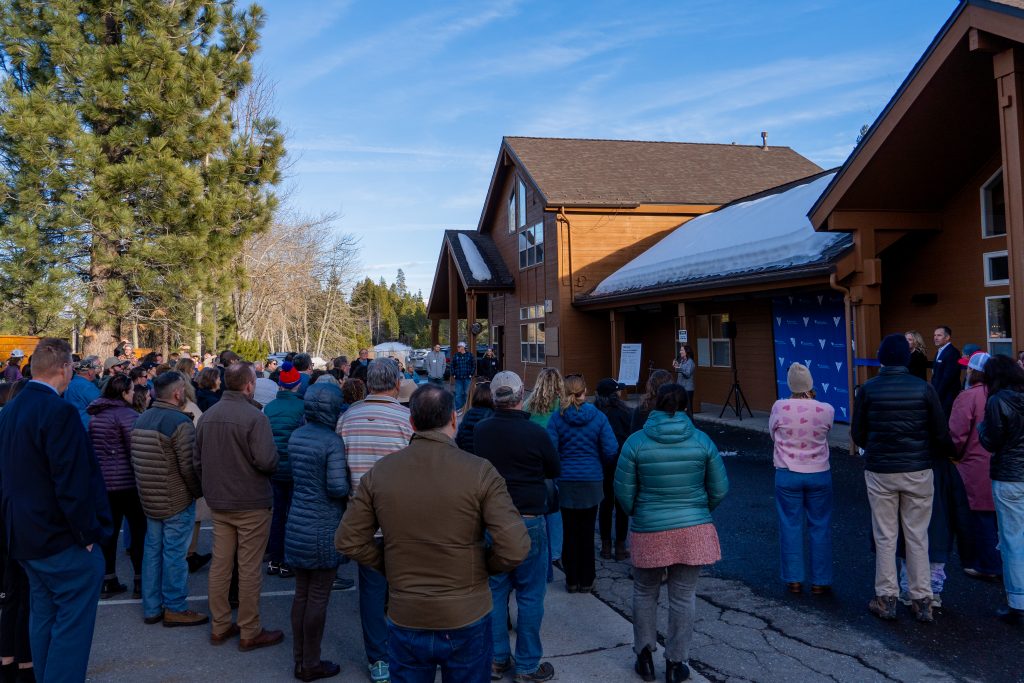
TRUCKEE, Calif. – On Friday, the Tahoe Truckee Homeless Action Coalition marked a milestone with a ribbon-cutting and open house for its one-year Navigation Center pilot in Truckee, a new resource designed to support residents experiencing homelessness with shelter, day services and case management.
The coalition announced the center’s target opening date as Feb. 25.
“Today, we should be proud of where we are, what we’ve accomplished and what this community made possible,” said Cindy Basso, founder of Fellowship of Compassion and TTHAC co-chair.
Tahoe Truckee Homeless Action Coalition announced the center’s target opening date as Feb. 25.
The center will be staffed 24 hours a day, seven days a week by Volunteers of America. It will offer six interim housing beds and 10 year-round shelter beds. The 10-person staff includes team members from Reno and the Truckee-Tahoe area. At least two staff members will be on site at all times.
“The weather forecast for the next week reminds me of the importance we have to safeguard our homeless from extreme weather,” said Jan Zabriskie , Town of Truckee Council Member and TTAHC co-chair. “That’s why we have a shelter here. It will assures stability and security for our homeless.”
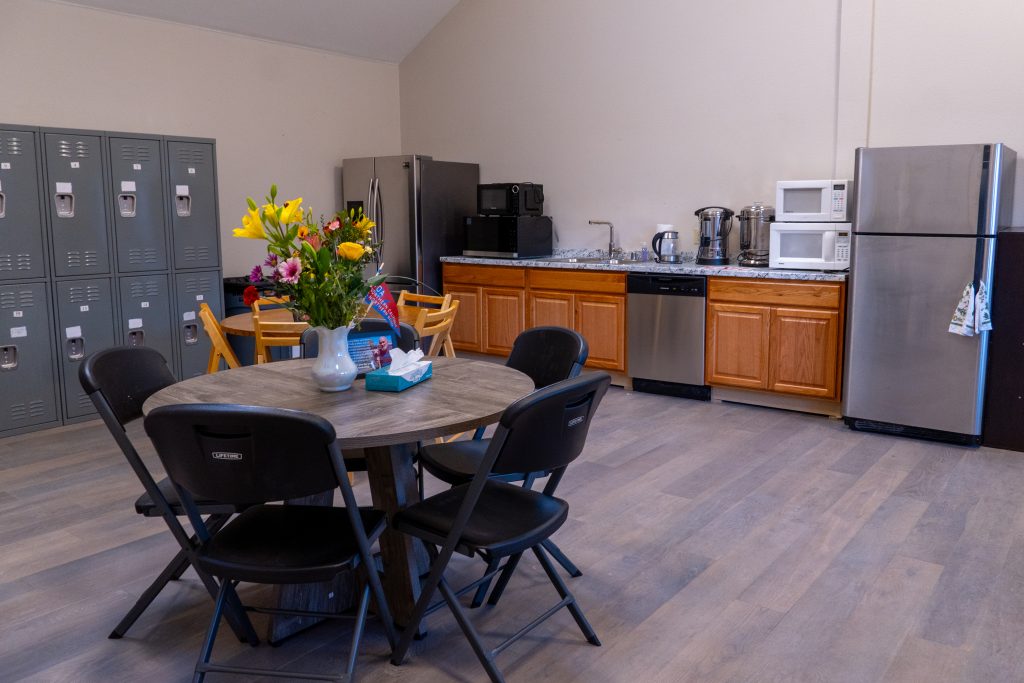
The Navigation Center’s common area.
During the open house, Shelter Manager Justin Jones walked attendees through the facility. He pointed out the front check-in station, where each person entering the building will be screened with metal detectors to prevent weapons, drugs, alcohol or other prohibited items from being brought inside.
Jones said the building’s layout was designed with safety in mind. Open space beneath bathroom stall doors allows staff to identify potential medical emergencies, such as someone fainting inside.
The main common area includes lockers adjacent to the kitchen, tables and shared amenities. Each resident will be assigned one locker and two tote boxes for personal belongings. Meals will be provided on site, with coordination through Meals on Wheels supplying a portion of lunches and dinners.
The Navigation Center will provide six interim housing beds and 10 year-round shelter beds.
Coalition leaders said the Feb. 25 opening represents a community-driven effort to address homelessness in Truckee through safety, dignity and comprehensive support services.
“My friend Ryan always says the human condition is non linear. It goes up, it goes down, it goes on a journey like all of us. This is a spot where people can find their next step in life,” said Hardy Bullock, District 5 Supervisor and TTHAC co-chair. “This is a place for food, for shelter, for justice support, wrap around services, substance use disorder counseling, therapy, all the things we all need every day in our lives but some people don’t have access to.”
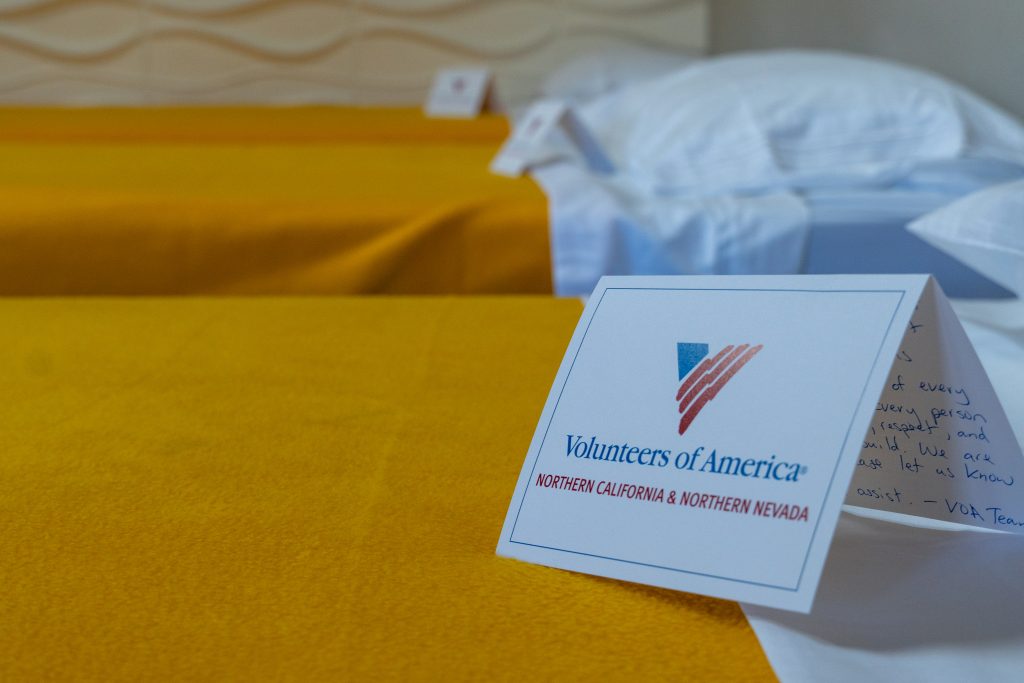
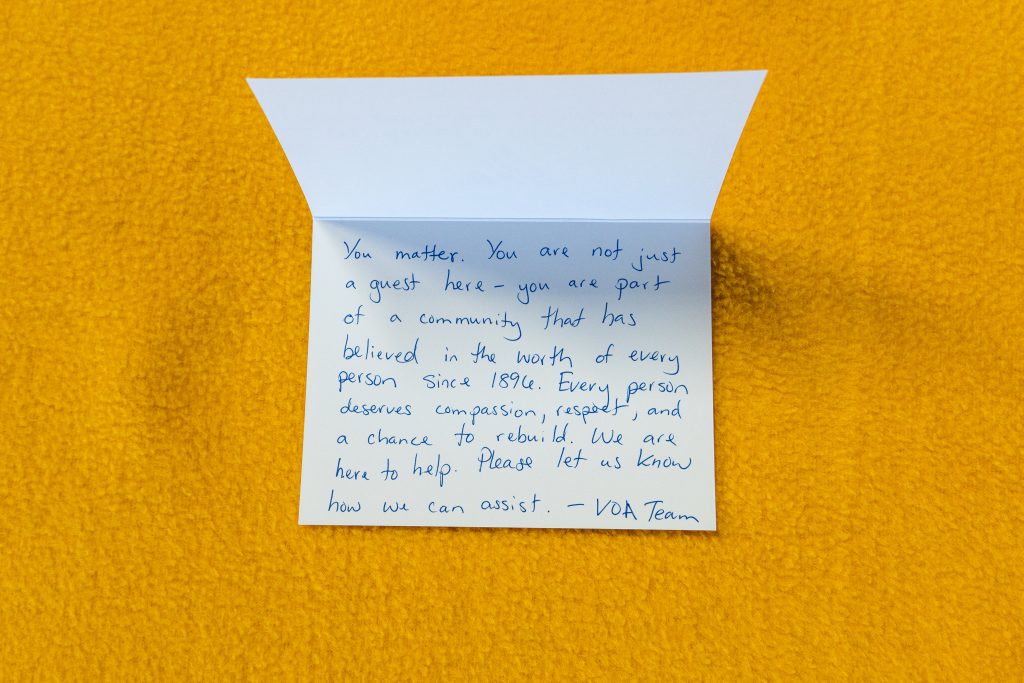
Each bed at the Navigation Center had a handwritten note.
We are thrilled to launch Voices for Housing, a new campaign dedicated to sharing Tahoe Truckee housing stories from our community. Over the next several months, we will introduce you to local residents from diverse personal and professional backgrounds who all have a unique housing story to share.
We start with Mary, a local artist and retiree who explains her deep connection to Kings Beach. Her story is a perfect example of why housing for all matters for the creative heart of our community.
The Voices for Housing campaign is made possible thanks to a generous grant from the North Tahoe Community Alliance’s TOT-TBID Dollars at Work Program.
After a surprising year of housing policy bipartisanship, lawmakers in Washington, DC are poised to continue pushing for housing supply and affordability solutions in 2026. At the same time, ongoing actions by the administration will continue to pose challenges to housing providers, developers, and the most housing insecure, while new and potentially forthcoming orders demonstrate a willingness to use executive power to address affordability concerns. As we head into an election year, there are several developments worth following in federal housing policy. This commentary previews the year ahead in Washington, DC.
Housing packages are poised to move forward in 2026.
By the end of 2025, both the House and Senate had advanced their own bipartisan bills to increase housing supply and promote affordability. And while the two packages (The ROAD to Housing Act in the Senate, and the Housing for the 21st Century Act in the House) have several unique and novel components, they also feature many overlapping and/or complementary features. Both packages have an opportunity to progress in the first half of this year before lawmakers turn their attention to the November election.
The ROAD to Housing Act, which passed out of the Senate Banking and Insurance Committee unanimously and was nearly passed into law as an amendment to the National Defense Authorization Act (NDAA),[1] contains several provisions that would have a positive impact on housing supply. These provisions include an expansion of the Rental Assistance Demonstration program (RAD) to preserve existing public housing,[2] reforms to existing federal loan products to support Accessory Dwelling Unit (ADU) financing,[3] and new programs leveraging existing federal dollars to promote more homebuilding in supply-constrained markets. As noted in a Terner Center commentary, the negotiation and advancement of ROAD to Housing represent a shift in how policymakers are approaching federal engagement on housing supply issues.
The Housing for the 21st Century Act advanced from the House Financial Services Committee on a vote of 50-to-1 just before the end of 2025. The Act includes provisions that are similar or identical to ROAD to Housing—for example, the Housing Supply Frameworks Act, reforms to the National Environmental Protection Act, and increases to Federal Housing Administration (FHA) mortgage insurance for residential multifamily construction. However, the proposed House legislation also includes a number of unique ideas that would support increases in housing supply and affordability. These include changes to the application of Build America, Buy America requirements for new homes using HOME Investment Partnerships Program (HOME) funding,[4] requirements that cities report on their progress toward reducing barriers to housing production as part of federal funding reporting, and an examination of how building code reforms could reduce the cost and complexity of homebuilding.
Lawmakers have limited time to move each package forward before members turn their attention to their respective 2026 election campaigns. In the Senate, ROAD to Housing must now be brought back to a vote of the full chamber. The next step for the Housing for the 21st Century Act will be a vote on the floor of the full House. Both could be advanced in the earlier part of the year, setting up a conference committee between the two chambers to send legislation to the president’s desk for signature into law.
The budget deal is poised to maintain funding for critical housing programs.
Senate and House members released their FY 2026 budget agreement on Tuesday, which generally maintains and even increases some funding for affordable housing and infrastructure programs, while increasing resources to vulnerable residents—despite earlier indications that those programs would face steep reductions. For example, lawmakers have proposed that the Community Development Block Grant (CDBG) Program and HOME both maintain the same funding levels as FY2025 after earlier facing nearly $1 billion less in last year’s budget proposal. In addition, $50 million is included for another round of the CDBG PRO HOME program, which provides support for localities pursuing land use and zoning reforms. Legislators have also proposed a funding increase over FY2025 levels for Housing Choice Vouchers (HCV), Project Based Rental Assistance, and Homeless Assistance Grants. Congress, which has been operating on a continuing resolution since November of last year, has until January 30 to vote on the full budget.
The budget deal also appears to include a solution for the Emergency Housing Voucher (EHV) program, which provides rental assistance to people experiencing or at risk of homelessness. EHV program funding was set to run out before the end of 2026. In the budget, $600 million is allocated to Tenant Protection Vouchers, which can be used to support current EHV holders. This is significant as our recent analysis notes that over 50,000 households nationwide are served through the program and would be at risk of losing that assistance.
The funding bill also includes language that would amend the U.S. Department of Housing and Urban Development (HUD’s) newly proposed guidelines for its largest homelessness program, the Continuum of Care (CoC) Program, which are currently suspended by a court order. HUD’s proposed funding criteria would have changed the CoC Program in many ways that would shift funding away from current permanent housing programs, potentially jeopardizing housing for 32,000 people in California. The bill would limit the extent to which HUD can make these shifts. It would also ensure funding continuity for current program awards that are scheduled to end prior to the next funding application process.
Executive Actions will continue to impact housing markets.
In addition to Congressional activity, the administration has signaled for several months that it has been working on Executive Actions to address housing supply and affordability, with President Trump saying in December that actions will include “some of the most aggressive housing reform plans in American history.”[5]
Statements from other administration officials signal that such actions could include the creation of new mortgage products and rule changes to allow for potential homebuyers to tap their 401(k) for down payments, as well as conditioning federal funds for states and cities on the adoption of policies to make it easier to build new homes. On January 20, President Trump also signed an Executive Order, which he alluded to in his remarks at the World Economic Summit, directing agencies to pursue initiatives aimed at curbing large institutional investor activity in the single-family home market. The Order would have the attorney general and the Federal Trade Commission review large acquisitions for anti-competitive practices and order other departments to promote sales to owner-occupants.
In addition, continued action on tariffs and immigration are likely to have a substantial impact on new supply. For example, multiple analyses by researchers and industry groups note that tariffs imposed or proposed in 2025 have the potential to increase the cost and uncertainty of new homebuilding. Increased deportation activity has also put a chill on residential construction labor supply, where immigrants comprise roughly a quarter of the labor force.[6] In California, more than two-thirds of California contractors cite skilled worker shortages as their top concern, and the state has faced a net loss of construction workers just in the last year.[7]
This year is likely to be consequential for housing affordability.
Polling going into this election year suggests that housing affordability will continue to be a consequential issue, and during campaign season, members of both parties are likely to want to showcase their efforts to advance meaningful legislation. Moreover, success on housing this year could set the table for even greater reforms in the next Congress and beyond. But for this momentum to continue into the next Congress, maintaining bipartisan support for housing solutions during what is likely to be a highly polarizing campaign will be critical.
Endnotes
[1] Lawmakers in Congress will often leverage “must-pass” bills to advance other priorities that are not relevant to the “must-pass” legislative vehicle. The NDAA is considered a “must-pass” bill to ensure funding for national defense.
[2] The RAD program allows public housing providers to rehabilitate existing units by leveraging private debt. We explored the potential of this program in a 2023 paper.
[3] A 2022 Terner Center paper explored the creation of loan products through existing federal programs specifically to provide homeowners with a broader selection of financing options.
[4] The Build America, Buy America Act (BABA) requires that all iron and steel, construction materials, and manufactured products used in federally funded infrastructure projects are produced in the United States. Affordable housing organizations have raised concerns that requiring affordable housing projects to adhere to BABA raises the cost of development.
[5] Samuels, B., & Manchester, J. (17 December, 2025). “Trump touts ‘warrior dividend’ checks, housing reform in address to nation.” The Hill. Retrieved from: https://thehill.com/homenews/administration/5654365-trump-primetime-address-housing-checks/
[6] National Association of Homebuilders. Concentration of Immigration in Construction Trades. Retrieved from: https://www.nahb.org/advocacy/industry-issues/labor-and-employment/immigration-reform-is-key-to-building-a-skilled-workforce/concentration-of-immigration-in-construction-trades
In this article by Andrew Burleson for Strong Towns published on January 20, 2026, the author argues the case for incremental infill housing. Large housing projects get a lot of time, attention and investment, but infill housing plays a critical role in housing supply. The full article is copied below.
I don’t live in San Francisco anymore, and I’m not writing to opine on the particular project. Rather, I want to share a few thoughts on this kind of project. Specifically, I think that large projects with shiny renderings tend to draw a disproportionate amount of pro-housing advocates attention. While projects like this will be part of the housing solution, I don’t think they’re the answer to our housing problems, and I don’t think we should overly focus on them.
Why do I say that?
First, large redevelopment projects will always be relatively few in number.
These projects require enormous skill and capital to execute. There aren’t that many developers with the access to capital or the skill to deploy many projects like this. I’m skeptical that there are even 100 development companies that could execute this kind of project.
Even if I’m wrong about how many developers are capable of delivering projects on this scale, there’s a finite number of sites that are viable for this kind of project. The Safeway in the Marina is uniquely under-developed relative to its location near the heart of America’s second most important city center, already surrounded by dense, mixed-use development. There’s no shortage of under-developed land, but most of it could not redevelop anywhere at anywhere near the level of the Marina site.
Opportunity sites tend to be clustered, and, ironically, when one site experiences a massive leap in development intensity it can stall the local market, and make the nearby opportunity sites harder to redevelop rather than easier.
Second, large redevelopment projects like this are uniquely political.
Because they are large, they’re extremely visible, and because they will always be relatively few in number, it’s easy for opponents to organize against them.
It’s also much easier to make people upset about something concrete — “this tower will block your view of the bay!” — than it is to rally against something abstract like single-stair reform.
Third, I’m skeptical that large projects like this could actually scale to meet the housing need in supply-constrained cities, even if they were politically easy to get approved and built.
No single project (of any scale) provides enough units to matter. Let’s assume, optimistically, the Marina project will make it through from concept to completion in 5 years. That means its delivering 158 units per year, which is great! But it’s nowhere near enough to meet San Francisco’s housing needs on its own.
As mentioned previously, there are a limited number of redevelopment sites that can even support large-scale projects like this.
Even we assume there were 100 capable firms executing these projects in parallel, and that they’d never run out of viable sites, that would net 15,800 units per year. That would be great! But, for context, it’s still less than the 20k + ADUs California has been adding annually.
Now, I’m not trying to argue that projects like this are good or bad, or that we should or should not do them. In the context of San Francisco, the Marina project makes sense to me, I think it should go forward. But I often run into pro-housing advocates who, I think, are overly focused on bulldozing the political obstacles in front of large-scale projects because they think that large-scale projects are the answer, singular. And I think that misunderstands the reality on the ground.
As a case in point, I’ve heard housing advocates characterize California’s ADU program as a modest “take what you can get” reform, even though ADUs are probably already adding more units per year than we could achieve via large-scale apartment projects. That’s an error in thinking.
Housing markets are not made of a few local projects, they’re made of regional aggregates. Even in smaller cities there are tens of thousands of lots, the biggest cities contain millions of parcels. Reforms that apply to millions of parcels are going to unlock more housing than reforms that only apply to hundreds of parcels.
Consider this napkin sketch to illustrate the point:
If we take the zip code 94116 as representative of the Outer Sunset, it contains 16,139 housing units in 2.53 square miles, or 6,379 units per square mile. The Outer Sunset is often criticized as an area that has resisted new housing units and needs to develop further—I agree with that. But there are several hundred zip codes in the Bay Area, and very few of them are near this level of development.
To take one example, let’s look at 94061, in Redwood City. The zip code is currently 54% as dense as the Outer Sunset; 14,006 housing units over 3.86 square miles, or 3,628 units per square mile. The area has some sites that could redevelop into apartment buildings, but the majority of lots are single family homes. The biggest opportunity is to open up new housing options for all those existing homeowners. That means allowing a family to build a backyard cottage for their aging parents to move into, a retiree to convert their basement into an accessory apartment for some extra cash flow, or a local builder to convert a run down house into a duplex or triplex.
If those options were allowed by right, this part of Redwood City could mature to the level of the Outer Sunset; still predominately single family residential, but up from 14,006 homes to 24,623, an increase of 10,617 homes.
There are 323 zip codes in the broader Bay Area, although some of these are quite far from the city, and some contain mostly mountainous terrain. If we passed reform that that permitted ten thousand new homes in half of these, it would unlock 1.6 million new homes.
TRUCKEE, Calif. – You don’t need to follow the news or attend public meetings to feel the undercurrent of anxiety and frustration related to housing in the North Lake Tahoe-Truckee region. Renters are barely hanging on, long-time local families are moving out of the area and employers are struggling to find and retain workers. The housing crisis isn’t new, and while progress has been made in advancing housing solutions, the need continues to outstrip what our current tools can deliver.
Over the last several years, Placer County and other local jurisdictions have taken important steps—dedicating staff capacity, advancing policy tools, investing in programs, and partnering regionally to increase housing options. That leadership matters. And at the same time, residents and employers are still asking the question that continues to surface across the region: What more can we do, and how do we move faster?
A little over a year ago, the Tahoe Housing Hub put out a call to the local community. They launched the ADU Accelerator Pilot program and invited homeowners to be part of the solution. The community stepped up in a big way. Staff from the Tahoe Housing Hub met with homeowners, walked their property, brought in engineers and planners, and tried to make the numbers pencil.
“It was incredible to see how many local people wanted to step up and be a part of the housing solution,” said Erin Casey, CEO of the Tahoe Housing Hub and Housing Tahoe. “They were willing to share their personal space with other members of the community so that local workers and families could also have a place to call home in Tahoe.”
What the pilot program made clear is that willingness is not the limiting factor—today’s costs and financing realities are. Programs like Placer County’s Launchpad incentives represent leadership and a commitment to housing. Yet even with those tools, many homeowners still face structural barriers: construction costs, financing constraints, insurance and utility realities, and the long-term requirements that often come with deed-restricted housing. In short: people want to help—and even with meaningful progress from local partners, many good-faith efforts still stall before they can become homes.
For years the North Lake Tahoe-Truckee community has been grappling with the same questions – what more can we do and how do we move faster to reach our housing goals? From the early efforts of Mountain Housing Council to programs like the ADU Accelerator and Launchpad, many ideas have been tried, each moving the conversation forward. The reality is that building in mountain communities is complex and expensive—and those pressures have intensified in recent years. At the same time, existing housing continues to sell at prices unattainable for many local workers and families.
That’s where Housing Trust Tahoe comes in – a new mechanism to immediately preserve existing housing and add units on a small scale, while working alongside local jurisdictions and regional partners. As a 501(c)(3) charitable organization, Housing Trust Tahoe is poised to acquire and preserve existing homes, accept donations of land or property, and leverage private dollars from employers, philanthropy, and individual donors alongside public investment. That means a homeowner or business who wants to help has more than one path: they can build, they can sell or donate a home or a lot, or they can contribute financially to keep naturally affordable housing in local hands.
Housing Trust Tahoe isn’t just “another nonprofit.” It is the culmination of years of community energy, leadership and urgency focused on providing homes for our neighbors – the people who teach our children, serve our food, plow our roads, and care for our elders. On December 9, 2025, the Placer County Board of Supervisors approved $500,000 to support the formation of Housing Trust Tahoe which will develop processes and feasibility assessment tools for property acquisition and launch land/housing donation campaign.
Housing Trust Tahoe now has a new call to action for the local community. Do you have a home or an empty lot that you’d like to donate in exchange for a tax deduction? Do you have resources—financial or otherwise—that you want to put to work locally? Housing Trust Tahoe is ready to partner with the community to purchase units and turn donations into homes for local workers and families.
“We are already in the process of accepting our first donation which will directly translate into homes for local workers. Housing Trust Tahoe is a culmination of all those years of energy, frustration and urgency that we’ve felt for so long. We finally have a mechanism to do more and do it quickly,” says Casey.
Housing affordability continues to strain workers and families in the North Lake Tahoe–Truckee region, where rising costs are pushing longtime residents out of the area.
Earlier this month, the Placer County Board of Supervisors approved $500,000 to support the formation of Housing Trust Tahoe, a nonprofit that will work alongside the Tahoe Housing Hub to preserve and expand workforce housing. The funding will be used to support staffing, legal setup, property evaluation, and outreach efforts related to housing and land donations.
“The $500,000 isn’t to make any particular purchases,” said Tim Cussen, a Tahoe housing specialist with Placer County. “It goes toward diligence for future property acquisitions or donations. We’re looking at preserving workforce housing, and maybe even adding units when possible.”
Housing Trust Tahoe builds on years of local housing efforts, including the Tahoe Housing Hub’s ADU Accelerator Pilot Program.
“It was incredible to see how many local people wanted to step up and be a part of the housing solution,” said Erin Casey, CEO of the Tahoe Housing Hub and Housing Trust Tahoe. “We finally have a mechanism to do more, and do it quickly.”
As a 501(c)(3) nonprofit, Housing Trust Tahoe can acquire and preserve existing homes, accept donations of land or property, and combine private and public funding to help keep housing affordable for local workers.
Leaders say the organization is already in the process of accepting its first property donation.
Housing 101: Breaking Down California’s 2025 Housing Legislation
September 18, 2025
The California Legislature ended its 2025 session over the weekend with a slew of new housing initiatives aimed at reducing costs and speeding up the process to build housing. The legislature passed a total of seven bills that now sit on Governor Newsom’s desk. He has until October 12 to sign or veto the bills.
**It’s important to remember that since development in the Lake Tahoe Basin is governed by the Tahoe Regional Planning Agency under a bi-state compact, state law sometimes doesn’t immediately apply or is modified within in the Tahoe Basin. Here’s a breakdown of the legislation:
Speeding Up Housing Approvals
AB 253 – The housing “shot clock” speeds up approvals by allowing home builders to hire a licensed third-party reviewer if local agencies can’t complete a permit review within 30 days.
AB 1308 – Creates another “shot clock,” this time for inspections. Jurisdictions must complete final inspections within 10 days for new residential buildings or additions of 1–10 units.
Expanding Housing Opportunities
AB 79 – Makes it faster and easier to build multifamily housing near transit stops, with requirements tied to the type of transit, its frequency, and the distance from housing to transit.
AB 1061 – Extends the provisions of SB 9 (2021)—which allows for lot splits and duplexes in single-family neighborhoods—to historic districts if existing historic structures are not altered or demolished.
Supporting ADUs and JADUs
SB 9 (2025) – Despite sharing the same number, this is different from SB 9 (2021). It reforms ADU ordinances by requiring local governments to bring them into compliance with state law and gives HCD the authority to void any local ordinances that create barriers to ADU construction.
AB 1154 – Clarifies rules for Junior ADUs (under 500 sq. ft.) by creating a unified set of standards, resolving confusion from overlapping rules, and making approvals faster and easier.
Making Housing More Accessible
AB 413 – Requires the Department of Housing and Community Development (HCD) to translate key state housing guidelines and handbooks into the non-English languages commonly spoken in California, so more homeowners and builders can understand their housing options.
Local Spotlight: Tahoe Basin
Closer to home, the Placer County Planning Commission recommended approval of the Tahoe Basin Area Plan Phase 2 Housing Amendments Their recommendation now moves to the Placer County Board of Supervisors, who will make a final vote on the Amendments later in 2025.
The Phase 2 Amendments apply to housing projects that are 100% deed-restricted and located within town centers in Kings Beach, Tahoe City and other areas zoned for multifamily housing and allow for greater flexibility related to building height, density and parking.
These new housing bills highlight the state’s ongoing efforts to address housing challenges by focusing on faster approvals, expanded opportunities, and clearer rules. Locally, we’re working closely with the Tahoe-Truckee Workforce Housing Agency, which has partnered with Sierra Business Council on state-level housing policy initiatives. You can track statewide legislation and get more in-depth analysis here.
This collaboration helps ensure our region’s housing needs are represented in Sacramento. We’ll also continue to share updates as these laws take shape and as local changes—such as the Tahoe Basin amendments—move forward. By staying informed, our community can better understand the evolving housing landscape and the opportunities ahead.
Housing in Tahoe/Truckee on the Regional and Statewide Radar
August 12, 2025
In July, the Tahoe Regional Planning Agency (TRPA) hosted the second round of community workshops for the Tahoe Living: Cultivating Community, Conserving the Basin project. At the North and South Shore meetings, more than 100 community members and workforce housing stakeholders provided input on fundamental changes to the permitting process for affordable housing projects and accessory dwelling units. TRPA has been hosting a series of bi-lingual workshops, webinars and working groups for the second phase of Cultivating Community, Conserving the Basin. The goal of this multi-year project is to create meaningful policy changes that can make housing more accessible in the Tahoe Region while maintaining and improving environmental protections. You can learn more about the project objectives, timeline, and how to get involved at tahoeliving.org.
Also in July, the Tahoe Truckee Community Foundation hosted Tomiquia Moss, California Secretary of Business, Consumer Services, and Housing for a dynamic conversation with local housing agencies and organizations including the Tahoe Housing Hub, Placer County, Town of Truckee and the Tahoe Truckee Workforce Housing Agency. Local housing leaders articulated Tahoe Truckee’s full housing landscape, from rural homelessness to workforce housing gaps and rising fire insurance costs to where State policy can leave mountain communities behind. The Secretary and her team came to learn about Tahoe-Truckee’s regional housing and forest-to-housing efforts as part of a greater, statewide effort hosted by the League of California Community Foundations.
LAKE TAHOE, Calif./Nev. – Building housing in any area requires a wide spectrum of housing, from transitional to affordable to market-rate and above. But because of pre-existing codes specific to the Tahoe area, building for the “missing middle” or multi-family housing is deeply disincentivized. And with continually rising market rates in the region, it makes it necessary to solidify housing within a certain area median income (AMI), though it often goes to affordable housing. For this article in the Tribune’s housing series, we’ll explain how these codes and contracts have impacted housing in Tahoe, and what changes are on the horizon for them.
What are development rights?
Even for those not in the know about development in the region, it’s still widely understood that Tahoe has garnered a reputation for being difficult to build in. The Tahoe Regional Planning Agency (TRPA) is responsible for creating Tahoe’s development rights system back in 1987 to disincentivize building and development. In the past, it’s undergone many changes in response to changing conditions in the region, but here’s how it works as it currently stands.
In order to develop a parcel of land in Tahoe, a developer must attain all the standard rights and permits as well as a development right. These are classified into three different types: tourist accommodation units (TAUs), commercial floor area (CFA) and residential units of use (RUUs).
To obtain development rights, developers can purchase them from the TRPA or through the TRPA’s marketplace from other developers who hold development rights. They can also purchase them from building departments or from the California Tahoe Conservancy (CTC) or the Nevada Tahoe Resource Team’s (NTRT) land banks. Lastly, developers can get development rights from buying and then restoring sensitive land parcels, which is also how the CTC and NTRT have banked their development rights. Development rights can be transferred from one property to another and can even be converted as the graphic shows.
A table showing how development rights are calculated between units.
However, one major oversight that the TRPA and the Tahoe Living Working Group (TLWG) identified is how development rights also disincentivize building affordable and multi-family units. No matter what size it is, an RUU is an RUU, meaning that to make the most of purchasing a development right, building bigger and more expensive housing pays better. Not only that, but an RUU also only counts for one. If a developer wants to build a triplex, then they need three RUUs, making it less appealing and more expensive to have multiple units on a parcel.
Robb Olson, a developer, architect and member of TLWG has primarily worked on custom homes and second homes. His clients typically have enough money to pay for the many restrictions and fees imposed on building in the basin, but he recognizes that’s not true for every development. “Uncertainty kills projects,” said Olson, “And much of what we do can be a weird, awkward process. It takes persistence to get to the finish line.”
According to Olson, the development rights marketplace can be a feast or famine situation, often with rights locked to the specific region of the basin that you’re in. These fees can be debilitating and come from multiple agencies, often requiring homeowners or new developers to invest time in learning the ins and outs or pay someone to help them through the confusing process.
In the case of some projects, these fees can build up to the point that what could have been workforce housing is removed or reduced in order to make the project pencil. Olson recounted a hunting lodge they were interested in turning into housing—but the eventual cost meant that the only profitable way to use the property was short-term rentals.
Bonus units and deed restriction
To make building housing more appealing and less expensive, the TRPA offers bonus units in exchange for deed restriction of a property.
Essentially, the TRPA keeps a certain amount of RUUs that they can grant for free, called bonus units. This reduces the cost for the developers and allows them to add more units. The TRPA has a certain number of bonus units they hold onto, and the pool is allocated so that 50% goes to affordable housing, 25% goes to moderate housing, and 25% goes to achievable housing. However, because affordable housing has been a major focus, the lower AMI focused tiers can pull from the higher tiers, meaning that in actuality, a higher percentage than half usually goes to affordable housing.
In exchange for these bonus units, the developer must adhere to the legal stipulations in the deeds indefinitely. Here in the basin, typically deed restrictions refer to keeping the prices for the property at a certain AMI, which maintains a housing supply of affordable housing.
The TRPA provides jurisdictions around the basin with bonus units that can be granted and with residential allocations, which are a development right used to create RUUs. The pools for each of those can be seen in the following graphic.
A reflection of basin-wide jurisdictions’ bonus units and residential allocations, as of June 25th, 2025.
Deed restriction challenges
Even outside of the TRPA’s jurisdiction, deed restriction is a key component for keeping prices more manageable for housing—the town of Truckee utilizes deed restriction in many of its properties across the AMI spectrum. But it presents its own challenge.
Deed restrictions here are often best incentivized through affordable housing. That’s not to say affordable housing isn’t necessary, but it does mean that new properties being built through deed restrictions are often for affordable housing, meaning the missing middle continues to miss out on new units that are being built.
As with recent projects like Dollar Creek Crossing, pitching deed restriction for mid-range AMIs is often a money sink. Private investment in the housing sphere is typically targeted towards affordable housing, where the federal government incentivizes it through low-income housing tax credits (LITC). For achievable, moderate and market-rate housing, no such incentives exist.
Local land trusts like St. Joseph’s Community Land Trust often make it easier for developers to leverage LITC. But awards for these projects often go to out-of-town developers—a large portion of the affordable housing here is built and managed by The John Stewart Company, whose closest office is in Sacramento. Some local developers have expressed that they feel like they’ve been passed over by county or city officials and that they don’t get a fair shake at creating affordable housing.
Patrick Taylor, owner of Alpine Corporation, has been trying to build deed restricted, achievable workforce housing in the region as a local in the area. He’s been working on the issue for years, but says that code changes and land shortages have made it far more challenging.
“There’s plenty of fees and loans that have to be dealt with,” said Taylor, referencing the development rights costs, fees for construction from multiple agencies and lawyers to help ensure deed restriction and other documents are legally binding. “There are these big hurdles and a multitude of agencies and requirements. Slimming that down would make the process much more streamlined, but right now, there are too many hands in the cookie jar, and miscommunication among a lot of them.”
Developers like Taylor have long expressed a desire to cut down the bureaucracy, and a high interest in increasing workforce housing incentives in residential and commercial areas. These would help protect environmental initiatives by reducing the need to commute, bringing people closer to public transit and their places of work.
The future of development rights
To its credit, the TRPA recognized the negative impacts that current development rights code has had on housing, and Phase 3 of the Cultivating the Community, Conserving the Basin plan (also called Tahoe Living) includes major code changes.
Currently, the summer and fall of this year is dedicated to exploring, defining and testing policy recommendations, including changes to the development rights system and associated codes. The end stage is expected to take place in winter and spring of 2026, where policy and code updates will be finalized.
Development rights are fairly restrictive in the Tahoe Basin, but not necessarily unique. Other areas of California, Maryland, Washington, New Jersey, New York and Colorado have development rights systems that the TRPA studied in 2021 to improve their system—some of which are being supported by TLWG and other housing advocates.
Olson laid out some of what TLWG members have been speaking about in recent meetings.
Re-evaluating coverage
Land coverage is an associated concept with development rights, as it monitors the use of human-made structures that replace the soil and change how sediment enters the lake. However, Olson hoped that potentially looking at increasing coverage for homes that are otherwise infiltrating their water or are located in town centers would make it easier to streamline building them. “Housing is mitigation enough,” said Olson, “Especially in town centers, it reduces VMT (vehicle miles traveled) and gets people using transit.”
Re-evaluating fees
There are fees aplenty in the Tahoe Basin, many of which unintentionally do the same thing as development rights and make it harder to build multiple units of housing. For example, VMT fees are evaluated per unit and are roughly $3,000—making it hard to justify building apartment complexes and other multi-family homes. “There are also a lot of fees that are missing because there’s a lack of equity in how those fees are applied,” said Olson. “Having agencies collect those missing fees could offset the cost of workforce housing.”
Codes and subsidies
While the TRPA reduces four possible fees for deed restricted housing, Olson asserted there is a need for true subsidies beyond these and bonus units. For example, agencies and jurisdictions could utilize a checking system that prioritized funding workforce housing projects with proximity to town centers and/or transit. Or they might focus on square footage of units rather than flat rates per unit, which would incentivize building more multi-family residences.
Fractional units
In Truckee, rather than counting bonus units as the same regardless of size, their bonus units are fractional. For example, a studio is equivalent to 0.5 of a bonus unit, while a two- or three-bedroom apartment is counted as 1 bonus unit. Olson called this a “compelling idea”, as more closely considering fractional units would make it easier to award more housing to deed restricted projects, as well as making it easier to get development rights for larger housing complexes.
The complex legal systems that are meant to protect Lake Tahoe’s environment have shifted in the past, and this major effort could make it easier for the basin to build workforce housing and match the growth happening in the region.
If you want to contribute to the TRPA’s conversations on development rights and other policies, they have two upcoming meetings in July. The South Shore workshop takes place on July 22 from 5 p.m. to 8 p.m. in the Bijou Community School, while the North Shore workshop takes place on July 23 from 5 p.m. to 8 p.m. in the Tahoe Community Foundation Trepp Room.
Share
STAY INFORMED AND STAY CONNECTED
Get important updates and timely information about workforce housing in our region.